Waukee Foundation Risk — Post-2000 Construction on Dallas County Loess-Till Deposits
Soil data, development timeline analysis, and seasonal risk patterns for Waukee homeowners — Iowa's fastest-growing suburb, almost entirely post-2000 construction on Dallas County's loess-over-glacial-till deposits, where foundations are young but the geology is ancient.
Waukee's almost entirely post-2000 housing stock sits on Dallas County's loess-over-glacial-till deposits, where a perched water table forms at the loess-till boundary and generates hydrostatic pressure at depths that standard water table monitoring does not predict. With foundations only 5 to 25 years old, Waukee's earliest subdivisions like Kettlestone are now entering the symptom window where efflorescence, basement humidity, and hairline horizontal cracking first appear in modern poured concrete construction.
How Does Glacial Till Beneath Waukee Generate Persistent Foundation Pressure?
Waukee sits entirely within Dallas County on a mixed glacial and loess deposit — the same two-layer soil profile that underlies western West Des Moines, but without the Polk County glacial-till-only zone that gives WDM its dual character. The foundation of the geological profile is the Dows Formation glacial till, deposited by the Des Moines Lobe of the Wisconsinan glacier 12,000 to 14,000 years ago. This till is 45 to 60 feet thick, composed of unsorted clay, silt, sand, gravel, and Cretaceous shale fragments. It carries a Hydrologic Soil Group D classification — the lowest infiltration rate, highest runoff potential — meaning water that enters the till has almost no efficient drainage path out.
On top of the glacial till sits a loess layer — windblown silt deposited after the glacier retreated — that creates the specific foundation threat Waukee homeowners face: the perched water table. Loess drains more readily than the till beneath it. Rainfall percolates through the loess until it reaches the till's impermeable surface, where it accumulates at the boundary. This pooled water creates a separate water table, perched above the regional groundwater level, that presses laterally against any foundation wall that intersects the loess-till transition depth. The foundation science page details how perched water tables generate pressure at depths that standard groundwater monitoring does not capture.
The loess-derived soils in Waukee — predominantly Sharpsburg, Otley, and Ladoga series — contain 35 to 42 percent clay in their subsoil horizons, giving them moderate swelling potential. This is meaningfully lower than the 60 to 80 percent clay content in Kansas City's montmorillonite formations. Waukee's soil does not produce the dramatic seasonal expansion and contraction that defines Kansas City's foundation threat. Instead, it produces persistent, relatively constant lateral pressure when saturated — hydrostatic loading that pushes against basement walls steadily rather than cycling between extreme states. The mechanism is slower but relentless, and it does not require the soil to dry out between pressure events to continue displacing the wall.
What Does Waukee's Explosive Growth Timeline Mean for Foundation Exposure?
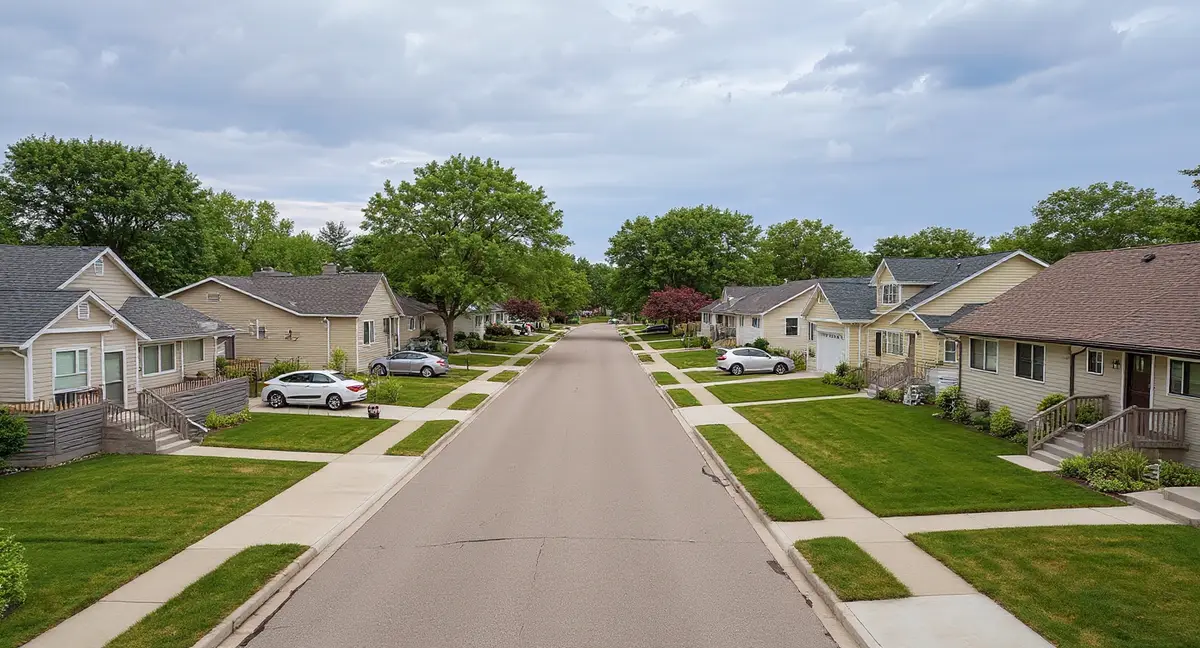
Waukee's population grew from approximately 5,000 residents in 2000 to more than 25,000 by the early 2020s — a fivefold increase that makes it the fastest-growing suburb in the Des Moines metro and one of the fastest-growing communities in Iowa. Nearly all of that growth came as residential subdivision construction on former agricultural land along the I-80 corridor. Kettlestone, Stratford Crossing, Sugar Creek, and dozens of smaller developments transformed Waukee from a small Dallas County town into a major suburban center within two decades. The practical consequence for foundations is that almost the entire city's housing stock is between 5 and 25 years old — a narrow age band sitting in the early portion of its exposure timeline on glacial till.
Glacial till does not distinguish between new construction and old construction — the hydrostatic pressure mechanism activates as soon as the water table rises against the wall, regardless of the building's age. What changes with time is the cumulative effect. A poured concrete wall that has endured 5 annual pressure cycles shows no visible damage. After 10 to 15 cycles, early indicators may appear: basement humidity that was not present when the home was new, mineral deposits on lower wall surfaces, or hairline cracking at the wall-floor joint. After 20 to 30 cycles, the same wall may develop measurable inward deflection — a bow that a straightedge reveals even if the homeowner has not noticed it visually. Waukee's housing stock is clustered in the 5-to-25-cycle range, which means the city is entering the phase where early symptoms become detectable across entire subdivisions simultaneously.
The construction quality in Waukee's post-2000 subdivisions is generally high — modern building codes, poured concrete basement walls, improved waterproofing membranes, and engineered grading plans. These features extend the timeline before visible symptoms appear compared to older block or stone construction. But they do not eliminate the underlying mechanism. A 2005 home in Kettlestone with a well-built poured concrete basement has endured 20 spring pressure cycles on Dallas County's loess-over-till profile. Horizontal cracks at or below grade level — the signature of hydrostatic wall loading — may be beginning to appear in the earliest-built portions of these subdivisions.
Waukee's rapid conversion from agricultural to residential land use also altered the local hydrology in ways that affect foundation performance. Farmland absorbs and distributes rainfall across large areas. Residential development replaces that absorptive capacity with impervious surfaces — roofs, driveways, streets, patios — that concentrate runoff into narrow drainage channels and the permeable strips around each home. This concentration increases soil moisture loading at the foundation perimeter compared to pre-development conditions. Early subdivisions that were built when surrounding land was still agricultural may now experience higher moisture loading than their designers anticipated, because subsequent development upstream has increased runoff volume reaching their drainage systems.
A Waukee homeowner in a 2008 Kettlestone home notices white powdery deposits on their basement walls every spring but no visible cracks. What does this indicate?
Which Foundation Symptoms Appear First in Waukee's 5-to-20-Year-Old Homes?
The earliest detectable symptom in Waukee's modern poured concrete foundations is not a crack — it is moisture. Before the wall deflects enough to fracture, hydrostatic pressure forces water through the concrete's natural porosity and through the wall-footing cold joint where the poured wall meets the footing. Homeowners notice this as increased basement humidity during spring, damp spots on the lower 12 to 18 inches of basement walls, or a musty smell that appears in March and persists through June. These moisture indicators are the first signal that the glacial till's water table is actively pressing against the foundation — a condition that precedes structural symptoms by years in well-built modern construction.
Efflorescence — white, powdery mineral deposits on basement wall surfaces — is a specific and visible confirmation of hydrostatic moisture movement through the wall. As water passes through poured concrete under pressure, it dissolves calcium compounds from the cement matrix and deposits them on the wall surface as it evaporates. Efflorescence in a Waukee basement does not mean the wall is failing. It means water is being forced through the concrete by pressure from the saturated glacial till on the other side. The presence of efflorescence during the March-through-June wet season, particularly on the lower half of basement walls, indicates active hydrostatic loading that will eventually produce structural symptoms if the pressure source is not managed.
Structural symptoms in Waukee's newer homes follow a predictable progression: wall-floor joint separation, followed by hairline horizontal cracking, followed by measurable wall bowing. The wall-floor joint — where the basement wall meets the floor slab — is the weakest point in the system because it is a cold joint, not a monolithic connection. Hydrostatic pressure pushes the wall inward at this joint first, opening a gap that admits water. Hairline horizontal cracking then develops at or near grade level, where the difference between soil pressure on the exterior and air pressure on the interior reaches its maximum. If left unaddressed, the wall develops a visible bow — typically measurable with a straightedge before it is visible to the eye.
Garage floor settling is one of the most common early complaints in Waukee subdivisions because garage slabs are thinner, less reinforced, and more exposed to frost cycling than basement floor slabs. Iowa's 42-inch frost depth means the entire soil column beneath a garage slab freezes and thaws annually. In glacial till, this cycling compacts the soil unevenly — particularly at the garage door opening where cold air penetration is greatest. Slab settlement at the garage apron, cracking along the center joint, and gaps between the slab and the foundation wall are symptoms that appear within the first 10 to 15 years of construction in Waukee's soil conditions.
When Does Waukee's Water Table Create the Most Foundation Stress?
March through June is the peak stress window, when snowmelt and spring rainfall raise the water table — including the perched table at the loess-till boundary — to its annual maximum. In Waukee's Dallas County soil profile, the standard water table sits 4 to 10 feet below grade during dry periods. But during the spring saturation window, sequential moisture inputs from snowmelt and rainfall stack in the poorly draining till, pushing the water table upward. The perched table at the loess-till boundary responds even faster because it sits in a shallower, smaller reservoir. A substantial April rain event can elevate the perched table within days, generating sudden lateral pressure against foundations at the loess-till transition depth.
May and June represent the rainfall peak — approximately 4.5 to 5 inches per month — arriving on top of soil that has been accumulating moisture since March snowmelt began. By late May, the glacial till has reached its maximum saturation state for the year. Hydrostatic pressure against basement walls is at its annual peak. This is when new cracks are most likely to appear, when existing cracks extend, and when basement moisture intrusion reaches its most visible state. Homeowners who check their basements only in summer or fall may miss the peak-stress indicators that appear during this window.
October through November marks a secondary risk period that sets up winter damage. Fall rainfall saturates the glacial till before the freeze season begins. Soil that enters winter fully saturated produces more aggressive frost heave because more water is available to form ice lenses within Iowa's 42-inch frost zone. These ice lenses — horizontal layers of ice that grow by drawing moisture from the surrounding soil — exert lateral forces against foundation walls at unpredictable depths within the frost zone. The frost heave damage compounds whatever hydrostatic damage accumulated during the previous spring, creating a year-over-year progression where each cycle leaves the wall slightly more displaced than the last.
Late July through September is the optimal window for foundation repair work and monitoring baseline establishment in Waukee. The water table recedes as rainfall decreases and evaporation increases, reducing hydrostatic pressure to its annual minimum. Soil conditions are most stable, excavation is most practical, and concrete products achieve optimal cure times in warm, dry conditions. For homeowners who noticed spring moisture or cracking, summer is the appropriate time to get a professional evaluation — the wall is at its least-stressed state, which provides the most accurate assessment of permanent deformation versus seasonal elastic behavior. The cost and economics page details how seasonal timing affects project scheduling and pricing.
What Should Waukee Homeowners Do Before Foundation Problems Progress?
Moisture management is the highest-leverage prevention measure for Waukee's newer homes because it addresses the pressure source rather than waiting to treat the structural consequence. Gutters and downspouts should discharge at least six feet from the foundation wall through extensions or buried drain lines. The grade around the foundation perimeter should maintain a minimum 6-inch slope over the first ten feet in all directions — a standard that newly built homes meet but that can deteriorate within a few years as backfill settles, mulch accumulates, and landscaping modifications alter the original contours. Re-establishing positive grade around Waukee homes built in the early 2000s is a low-cost action with meaningful long-term benefit.
For homes already showing early symptoms — basement humidity, efflorescence, or hairline cracking — interior drainage systems and sump pump installation can relieve hydrostatic pressure before it produces structural displacement. An interior drain system collects water at the wall-footing joint and routes it to a sump basin for removal, reducing the head of water pressing against the wall. In Waukee's loess-over-till profile, the drain system should be designed to intercept water from both the regional water table and the perched table at the loess-till boundary — a dual-depth consideration that single-depth drain designs may not fully address.
Wall stabilization for early-stage bowing — less than 1 inch of deflection — can be addressed with carbon fiber straps that bond to the interior wall surface and prevent further inward movement. Carbon fiber is appropriate for Waukee's newer poured concrete walls because the concrete surface is typically in good condition, providing strong adhesion for the epoxy bond. For more advanced bowing, wall anchors driven through the soil to reach stable material beyond the pressure zone provide active resistance that can potentially restore the wall toward its original position over time as the anchors are tightened during low-moisture periods.
Slab settlement — the most common early repair need in Waukee's subdivisions — is typically addressed with polyjacking, which injects expanding polyurethane foam beneath the slab to fill voids and lift the concrete to its original elevation. Polyjacking is effective in glacial till environments because the foam fills the voids created by till compaction and frost heave cycling without relying on the till's bearing capacity to hold the lift long-term. The foam's closed-cell structure also provides a moisture barrier between the till and the slab bottom, reducing future moisture transmission through the concrete. For Waukee's garage floors and driveway slabs, polyjacking typically costs less than half the price of full slab replacement and can be completed in a single day.
Monitoring is especially important in Waukee because the entire city's housing stock is compressed into a narrow age window — and the glacial till beneath all of it operates on the same timeline. As the oldest Waukee subdivisions cross the 20-to-25-year threshold, symptom frequency across the city will increase collectively rather than appearing in scattered individual homes. The homeowner's guide provides a seasonal monitoring checklist designed for Iowa's glacial till environment, including specific measurements and observations appropriate for each phase of the annual moisture cycle.
- Waukee sits entirely in Dallas County on loess-over-glacial-till deposits where a perched water table at the loess-till boundary generates hydrostatic pressure at depths that regional water table data does not capture.
- Nearly the entire city's housing stock is 5 to 25 years old — a compressed age band entering the symptom window simultaneously, meaning foundation issues will appear across entire subdivisions rather than in isolated homes.
- The earliest symptoms in Waukee's modern poured concrete are moisture-related — basement humidity, efflorescence, and damp spots — which precede structural cracking by several years.
- Rapid conversion from farmland to residential development increased impervious surface coverage and concentrated runoff around foundations, elevating soil moisture beyond pre-development conditions.
Waukee Foundation Questions
Can new homes in Waukee really have foundation problems after only 10 to 15 years?
Yes. Modern poured concrete foundations resist glacial till pressure more effectively than older block or stone construction, but they do not eliminate the underlying mechanism. The Dows Formation glacial till beneath Waukee generates hydrostatic pressure against basement walls every time the water table rises — which happens annually during the March-through-June peak moisture period. After 10 to 15 annual pressure cycles, even well-built poured concrete can begin showing early symptoms: basement humidity increases, minor efflorescence on wall surfaces, or hairline horizontal cracking at grade level. These are not construction defects — they are the predictable result of persistent lateral pressure acting on the wall over time. The loess-over-till profile in Dallas County adds a perched water table variable that can produce localized pressure spikes earlier than the regional water table timeline would suggest.
What is a perched water table and why does it matter in Waukee?
A perched water table forms when a permeable soil layer sits on top of an impermeable one. In Waukee, the upper loess — windblown silt deposited after the Wisconsinan glacier retreated — drains more efficiently than the glacial till beneath it. Rainwater moves downward through the loess until it reaches the till surface, where it stops because the till will not absorb it quickly. Water pools at this loess-till boundary, creating a perched table that is separate from and usually shallower than the regional water table. This perched table can sit within the depth range of basement walls, pressing laterally against the foundation at a point that standard water table data would not predict. In subdivisions like Kettlestone and Sugar Creek, where construction disturbed the original soil layering during grading and backfill, the loess-till boundary may be irregular — meaning the perched table's depth and behavior vary across a single lot.
How does Waukee's rapid growth affect the foundation risk for early subdivisions like Kettlestone?
Rapid development changes the hydrology of the surrounding area. When farmland is converted to residential lots, the impervious surface area — roofs, driveways, streets — increases dramatically. Rainfall that previously infiltrated across acres of agricultural soil is now concentrated into storm drains, gutters, and the narrow strips of pervious ground around each home. This concentration increases soil moisture loading around foundations compared to the pre-development condition. Kettlestone, as one of Waukee's earlier major subdivisions, has experienced this transition: the surrounding area was open land when it was built, but continued development has increased impervious surface coverage, altered drainage patterns, and potentially elevated local soil moisture. Homes at the low points of Kettlestone's grading plan are most susceptible to this accumulated runoff effect.
Should Waukee homeowners on slab-on-grade foundations worry about the same glacial till issues?
Slab-on-grade foundations face the same glacial till environment but through a different loading mechanism. Where basement walls experience lateral hydrostatic pressure, slabs experience vertical pressure from below as the water table pushes upward against the slab bottom. In Waukee's glacial till, where the water table can rise to within 2 to 3 feet of the surface during spring, slabs without adequate sub-slab drainage can experience uplift pressure that causes cracking, heaving at joints, and moisture transmission through the concrete. Iowa's 42-inch frost depth adds another slab-specific risk: frost heave beneath the slab perimeter — where the ground freezes deepest because it is exposed to cold air — lifts the slab edges while the center remains stable, producing the classic dome-shaped heave pattern. Slab-on-grade homes in Waukee should maintain positive drainage away from the slab edge and monitor for cracking patterns that radiate from the perimeter inward.
When should Waukee homeowners start monitoring their foundations for problems?
Monitoring should begin by the tenth year after construction — the point at which Dallas County's loess-over-till profile has cycled through enough wet-dry seasons to potentially produce early symptoms in poured concrete foundations. The monitoring itself is straightforward: inspect basement walls for horizontal cracking, efflorescence, or damp spots during the peak moisture months of March through June, when hydrostatic pressure is highest. Use a straightedge or string line against basement walls to check for inward bowing — any deflection over one-quarter inch warrants professional evaluation. Check garage floors and basement slabs for new cracks or uneven surfaces. Note whether interior doors that operated smoothly when the house was new have begun sticking seasonally. These observations, documented annually during the spring wet season, create a timeline that distinguishes normal seasonal variation from progressive structural movement.