Raytown, Missouri Foundation Risk Profile
Soil data, housing stock analysis, and seasonal risk patterns for Raytown homeowners — an inner-ring Jackson County suburb with the metro area's heaviest clay concentration, a predominantly postwar housing stock, and the compounding risk that comes from block basements aging past 60 years on expansive soil.
Raytown sits on the densest, least-diluted Wymore-Ladoga clay concentration in the entire Kansas City metro, and its 1940s-1960s block basement housing stock has undergone 60 to 80 years of cumulative shrink-swell cycling on that soil. The combination of the metro's most aggressive clay with its most vulnerable common wall type — concrete block with mortar joints — produces one of the highest baseline foundation risk profiles in the region.
Why Does Raytown's Soil Threaten Foundations More Than Most Kansas City Suburbs?
Raytown sits on the core of Jackson County's Wymore-Ladoga clay complex — the densest, least-diluted concentration of this montmorillonite clay formation anywhere in the Kansas City metropolitan area. The USDA classifies this soil as "very high" shrink-swell potential with 60 to 80 percent clay content and Hydrologic Soil Group D, meaning it has the lowest infiltration rate and highest runoff potential in the federal classification system. While suburbs on the Kansas side of the metro and outer Jackson County locations also sit on Wymore-Ladoga, the central Jackson County formation beneath Raytown carries the highest montmorillonite density — the specific mineral responsible for the extreme volume changes that damage foundations. The foundation science page explains how montmorillonite's layered crystal structure absorbs water molecules between sheets, driving the volume expansion that generates thousands of pounds of lateral pressure per linear foot of wall.
Unlike Johnson County suburbs where Peorian loess deposits up to 17 feet thick overlay or intermix with the clay and partially moderate its behavior, Raytown's soil profile shows less loess dilution — the Wymore-Ladoga clay is closer to the surface and more homogeneously distributed. This matters because loess — while introducing its own collapse risk under saturation — does dampen the extreme shrink-swell amplitude of pure montmorillonite clay. With less loess moderation, Raytown's soil cycles through a wider amplitude of expansion and contraction with each wet-dry season than comparable soil profiles in Overland Park or Lenexa. The practical result is more pressure against basement walls during wet spring months and more bearing loss under footings during dry summer months.
Raytown's inner-ring location means it is fully surrounded by Kansas City proper, with no rural transition zones or undeveloped land buffers at its edges — the entire city is built out, paved, and graded. Decades of impervious surface coverage from roads, driveways, and rooftops have altered natural drainage patterns from their pre-development state. Rainwater that once infiltrated gradually across open ground now concentrates in storm systems, collects against foundations, and creates localized saturation zones where the clay experiences maximum expansion. The absence of undeveloped drainage outlets at the city's perimeter means water management is entirely dependent on municipal storm infrastructure and individual property grading.
The 36-inch frost depth across Raytown means three full feet of this heavy clay undergoes annual freeze-thaw cycling — and in a soil with this concentration of montmorillonite, the water content entering winter is typically high enough to produce significant ice lens formation. Ice lenses in clay generate upward heave forces on slabs and lateral forces on walls that compound the spring expansion pressure. The frost zone intersects the most structurally critical portion of the foundation wall — the upper three feet where lateral clay pressure is already highest because overburden is lowest. This intersection of maximum frost action with minimum overburden restraint is why the upper portions of Raytown basement walls are often the first to show cracking.
How Does Raytown's Postwar Housing Stock Compound the Soil Risk?
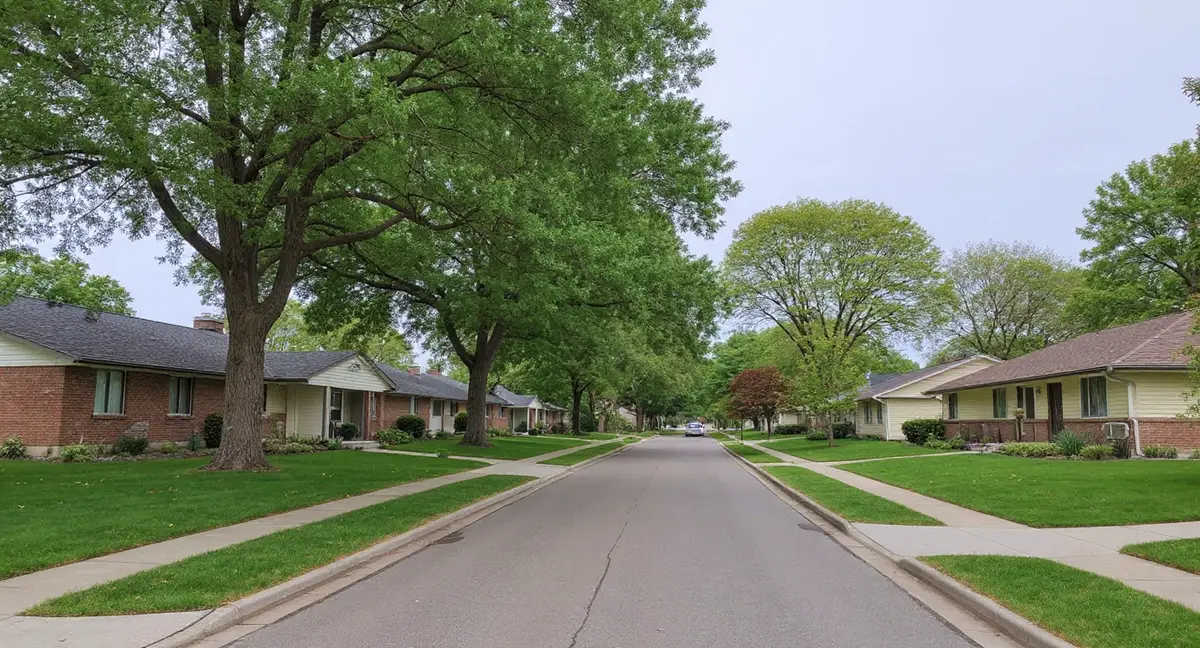
Raytown's residential development occurred overwhelmingly between the mid-1940s and the mid-1960s — the postwar suburban expansion that also built Prairie Village across the state line in Kansas — making Raytown's housing stock among the oldest suburban construction in Jackson County outside of Kansas City proper. This is not a city with multiple development eras producing a mixed-age housing inventory. Raytown is substantially a single-era suburb: postwar ranches and split-levels built during the two-decade window when concrete block was the dominant basement wall construction method in the Kansas City area. The result is a city where the overwhelming majority of foundations share the same age, the same construction type, and the same soil — a combination that creates a cohort risk profile where the entire city's housing stock crosses damage thresholds at roughly the same time.
Concrete block basement walls — the signature construction of Raytown's postwar era — are structurally weaker under lateral clay pressure than the poured concrete walls that became standard in suburbs built from the 1970s onward. Block walls consist of individual masonry units stacked and bonded with mortar. The mortar joints between blocks are inherently weaker than the block material itself, creating planes of weakness that the clay exploits. When Wymore-Ladoga clay expands against a block wall, the wall fails along its mortar joints in a characteristic stair-step pattern — diagonal cracks stepping through alternating horizontal and vertical mortar lines. This failure mode is progressive: once the mortar joint opens, water enters the crack, accelerating deterioration through freeze-thaw cycling and further reducing the wall's resistance to the next expansion event.
The 63rd Street corridor and the neighborhoods flanking Blue Ridge Boulevard form Raytown's residential core, with the densest concentration of 1950s-era homes in the city. These neighborhoods were among the first to develop as Raytown grew from a small crossroads community into a suburban city. Homes in this core are now 70 to 75 years old — well past the age at which block walls on heavy clay show structural distress. The postwar ranch floor plan that predominates here typically features a full basement with four block walls, a poured concrete floor slab, and minimal or no waterproofing membrane on the exterior — waterproofing standards for residential construction were minimal in the 1950s. The absence of exterior waterproofing means the block walls have been absorbing moisture from the clay through their exterior face for seven decades.
Areas near Gregory Boulevard on Raytown's southern edge and the neighborhoods approaching the Little Blue River to the east contain some later construction from the late 1960s and early 1970s, including the earliest poured concrete basements in the city. These transitional-era homes occupy a slightly better position in the risk profile: younger age and stronger wall construction. However, they still sit on the same core Jackson County Wymore-Ladoga clay and have accumulated 50-plus years of exposure. Late-1960s poured concrete on this clay is old enough to show vertical cracks from lateral bowing and general crack patterns that indicate the wall has begun to flex under cumulative load.
Raytown's block basements show stair-step cracks through mortar joints at higher rates than newer Lee's Summit poured concrete walls. Why does the block construction method make Raytown walls more vulnerable to Wymore-Ladoga clay pressure?
What Foundation Symptoms Define Raytown's Risk Pattern?
Stair-step cracking through mortar joints in block basement walls is the defining foundation symptom across Raytown — the visual signature of postwar block construction failing under decades of lateral Wymore-Ladoga pressure. These cracks trace a diagonal path from corner to corner of the wall, stepping through alternating horizontal bed joints and vertical head joints as they follow the weakest path through the masonry assembly. A single stair-step crack may indicate localized settlement or a point-loaded section of wall. Multiple stair-step cracks on the same wall, or matching patterns on opposing walls, indicate a broader lateral pressure condition that is moving the wall as a unit. The difference between these two readings determines whether localized repair or full-wall stabilization is the appropriate response.
Inward bowing of block basement walls is the progression beyond stair-step cracking — it means the wall has moved past the point of mortar joint failure into physical displacement of the wall plane itself. A block wall that has bowed inward more than half an inch at its mid-height is no longer performing as a structural element in the way it was designed. The wall is transitioning from a rigid bearing member to a flexible panel, and the rate of further movement accelerates because the wall's reduced rigidity offers less resistance to the next expansion cycle. Horizontal cracks at or near mid-height of the wall typically accompany bowing and represent the hinge point where the wall is folding inward. Stabilization with carbon fiber straps or wall anchors is designed to arrest movement at this stage before displacement reaches a threshold requiring wall replacement.
Above the basement, Raytown homeowners frequently observe the secondary symptoms of foundation movement: doors that stick or swing open on their own, gaps between trim and wall surfaces, and sloping floors detectable with a level or by feel. These upper-story symptoms are the structural frame translating basement-level movement into visible effects throughout the house. A block wall that has bowed inward by one inch at its mid-height transfers that displacement upward through the sill plate and floor joists, creating a measurable slope in the floor above. Doors hung in frames that have racked from this displacement bind at the top corner on the side toward the settling — a diagnostic clue that identifies which wall is driving the movement.
Water infiltration through block wall cracks is pervasive in Raytown's older homes because the block walls lack exterior waterproofing membranes and the mortar joints that have cracked under clay pressure become direct water entry pathways. During spring rains, water under hydrostatic pressure from the saturated clay forces through every open mortar joint and crack face in the wall. The water entry itself compounds the structural problem: it carries dissolved minerals that precipitate as efflorescence on interior surfaces, it saturates the block units and reduces their compressive strength, and it creates interior moisture conditions that deteriorate floor framing and sill plates resting on the wall top. Addressing water entry without addressing the structural wall movement treats a symptom while the underlying problem continues to advance.
When Does Raytown's Foundation Risk Peak Each Year?
Raytown's peak foundation loading period runs from April through June, when spring rainfall building toward the May average of 5.7 inches brings the heavy Wymore-Ladoga clay from winter thaw to full saturation and maximum expansion — generating the highest lateral pressure against basement walls at any point in the annual cycle. This is the window when new cracks appear, existing cracks widen to their seasonal maximum, and doors that operated normally through winter begin to stick. Because Raytown's block walls are already structurally compromised by decades of cumulative damage, the spring pressure peak can push walls past a threshold in a single season that would take a younger poured concrete wall several more cycles to reach.
The secondary risk period runs from late July through September, when summer heat and reduced rainfall drive the clay to its annual minimum moisture content, contracting it away from foundation footings. This contraction phase creates settlement risk rather than pressure risk. As the clay pulls away from the footing, it removes the bearing support that was holding the foundation at grade level. The corners of the foundation are most vulnerable because they have two exposed faces losing moisture simultaneously, while the center of each wall retains soil contact longer. This differential produces the diagonal cracking that tracks from corner to corner through drywall, brick veneer, and block walls. Raytown's fully built-out, impervious-surface-covered landscape concentrates the drying effect because there are no permeable buffer zones to moderate soil moisture transition.
Winter freeze-thaw cycling between December and February adds a third damage mechanism, particularly significant for Raytown's block walls because water that entered through cracked mortar joints during the previous wet season freezes inside the wall assembly. Ice forming in mortar joints and block cores expands by approximately 9 percent by volume, mechanically widening the cracks that admitted the water in the first place. Each freeze-thaw cycle ratchets the crack slightly wider, allowing more water entry in the next thaw, which produces more ice in the next freeze — a progressive deterioration loop that accelerates through each winter. The 36-inch frost depth ensures this process extends to the full depth of the most structurally critical zone of the wall.
What Steps Should Raytown Homeowners Take Right Now?
The first priority for any Raytown homeowner who has not recently inspected their basement walls is a systematic visual assessment — walking each wall and documenting every crack, stain, efflorescence deposit, and any visible bow or lean in the wall surface. Use a straightedge or a taut string line held against the wall to check for inward deflection that may not be obvious to the eye. Photograph each wall from the same position and record the date. This baseline documentation is the foundation of every subsequent decision about monitoring versus repair. Without a documented starting point, there is no way to determine whether a crack discovered six months later is new or was already present.
Surface water management is the most accessible and highest-return preventive action for Raytown homes — keep water away from the foundation perimeter to reduce the amplitude of the wet-dry soil cycle that drives clay movement. Downspouts should discharge at least six feet from the wall via extensions or underground drain lines. The grade adjacent to the foundation should fall at least six inches over the first ten feet in all directions. In Raytown's older neighborhoods, decades of settling, mulch accumulation, and landscape changes have often reversed the original grading — soil now slopes toward the foundation rather than away from it. Re-grading to restore positive drainage is a weekend project with significant long-term payoff. The homeowner's guide provides a step-by-step drainage assessment checklist.
For block walls showing active stair-step cracking or measurable inward bowing, a structural assessment by a licensed engineer or experienced foundation contractor establishes whether the wall can be stabilized in place or requires more extensive intervention. Carbon fiber straps and wall anchors can arrest movement on walls that have bowed less than approximately two inches — locking the wall in its current position and preventing further displacement. Walls beyond that threshold may require partial or full wall replacement. The cost page documents how the scope and cost of block wall repair escalates with displacement distance, making early assessment the most cost-effective strategy.
Eastern Raytown homeowners near the Little Blue River drainage influence should add water table monitoring to their assessment process — a wet basement floor after rain is not just a nuisance but a signal that hydrostatic pressure is actively loading the foundation walls from the exterior. Sump pump systems with battery backup address the water management component, but they do not address the structural pressure that the same water is exerting against the block walls. In river-adjacent properties, water management and structural stabilization are separate problems that often need to be addressed together for either solution to be effective long-term.
- Raytown sits on core Jackson County Wymore-Ladoga clay at its highest metro concentration — less loess dilution means wider shrink-swell amplitude and more pressure against basement walls than comparable Clay County or Johnson County sites.
- The city's 1940s-1960s block basement majority has accumulated 60 to 80 years of cumulative mortar joint damage, placing most homes well past the threshold where visible structural distress becomes common.
- Block walls showing horizontal cracking at mid-height with any measurable inward bow should be evaluated professionally — this combination indicates active lateral displacement that drainage management alone cannot reverse.
- Raytown's fully built-out, impervious-surface-covered landscape concentrates runoff at foundation perimeters, making surface water management the highest-return preventive action available to homeowners.
Raytown Foundation Questions
Why is Raytown's foundation risk higher than newer Jackson County suburbs like Lee's Summit or Blue Springs?
Raytown's foundation risk is elevated by two compounding factors that newer suburbs do not share. First, the housing stock is predominantly 1940s through 1960s construction — 60 to 80 years old on Wymore-Ladoga clay — giving the soil six to eight decades of cumulative shrink-swell cycles to work against foundation walls and footings. Lee's Summit and Blue Springs homes are typically 30 to 50 years old, meaning they have experienced roughly half the cumulative clay exposure. Second, Raytown's postwar-era homes overwhelmingly used concrete block basement construction rather than the poured concrete that became standard in later decades. Block walls are inherently weaker under lateral clay pressure because the mortar joints between blocks create planes of weakness that the clay exploits through stair-step cracking. The combination of older age and weaker wall construction places Raytown in a higher baseline risk category than suburbs that developed later.
What does it mean that Raytown sits on the heaviest Wymore-Ladoga clay concentration in the metro?
Jackson County carries the densest, most continuous concentration of Wymore-Ladoga clay complex in the Kansas City metropolitan area. While Johnson County on the Kansas side also has Wymore-Ladoga, the Jackson County formation — particularly in the central-county zone where Raytown sits — shows the highest clay percentages and the least dilution from loess or alluvial deposits that moderate the clay in other locations. In practical terms, the soil beneath Raytown foundations has more montmorillonite clay per cubic foot than most other metro-area locations. Montmorillonite is the specific mineral responsible for shrink-swell behavior: it absorbs water into its crystal structure and expands dramatically, then releases that water and contracts. Higher concentrations mean greater volume change per moisture cycle, which translates directly to more pressure against foundation walls during wet seasons and more bearing loss under footings during dry seasons.
Are Raytown's concrete block basements repairable, or do they need full replacement?
Most Raytown block basements are repairable without full replacement, though the appropriate method depends on how far the damage has progressed. Block walls that show stair-step cracking through mortar joints but have not moved inward more than about three-quarters of an inch can typically be stabilized with carbon fiber straps or wall anchors — methods that arrest further movement and reinforce the wall in its current position. Walls that have bowed inward more than two inches or have begun to lose mortar integrity across multiple courses may require more extensive intervention, potentially including partial or full wall replacement. The key distinction is whether the wall has retained its structural capacity to carry the vertical load of the house above it. A structural assessment that measures the wall's deflection and maps the crack pattern determines which category a given wall falls into.
How does the Little Blue River affect foundation risk in eastern Raytown?
The Little Blue River runs along Raytown's eastern boundary and creates a flood plain corridor where alluvial soils — deposited by historical river flooding — overlay or mix with the native Wymore-Ladoga clay. In these areas, foundations sit on a mixed soil profile that combines the shrink-swell behavior of the clay with the compressibility of the alluvial deposits. The river also maintains an elevated water table in adjacent low-lying terrain: after significant rainfall, these areas can remain saturated for extended periods as the river's water level slows drainage from surrounding soils. The practical effect for eastern Raytown homeowners is that their foundations face both the standard clay shrink-swell risk and an additional hydrostatic pressure component from the river-influenced water table. Basement wall seepage and efflorescence are more common in this zone.
Should Raytown homeowners monitor foundations differently than homeowners in newer suburbs?
Yes, because the age and construction type of Raytown's housing stock warrant more frequent and more specific monitoring than newer poured-concrete homes. Block basement walls should be inspected at least twice per year — once in late spring when clay is at maximum expansion, and once in early fall when clay has contracted to its seasonal minimum. The specific things to look for are new stair-step cracks in mortar joints, widening of existing cracks compared to previous observations, any visible inward lean or bulge in the wall surface, and water entry through crack faces or at the wall-floor joint. Photographing each wall section from the same position in the same season each year creates a comparison record that reveals progressive movement. In newer suburbs, annual inspection may be sufficient because poured concrete walls show symptoms more slowly — but block walls in the 60-to-80-year age range can deteriorate between seasonal cycles.