Raymore Foundation Risk — Cass County Prairie Clay, Newer Construction, and Southern Metro Growth Dynamics
Soil mechanics, housing stock analysis, and seasonal risk data for Raymore, Missouri — a fast-growing Cass County suburb on the southern fringe of the Kansas City metro, where prairie-derived clay soils and post-1990 construction create a foundation risk profile distinct from the inner-ring Jackson County suburbs.
Raymore sits on Cass County prairie-derived clay — a distinct soil from Jackson County's Wymore-Ladoga that retains moisture longer and produces a compressed but persistent shrink-swell cycle against foundations. As an overwhelmingly post-1990 suburb with significant slab-on-grade construction, most Raymore homes are in the early-to-mid exposure window where first-generation symptoms like cracked floor tile and minor drywall cracks are just beginning to appear.
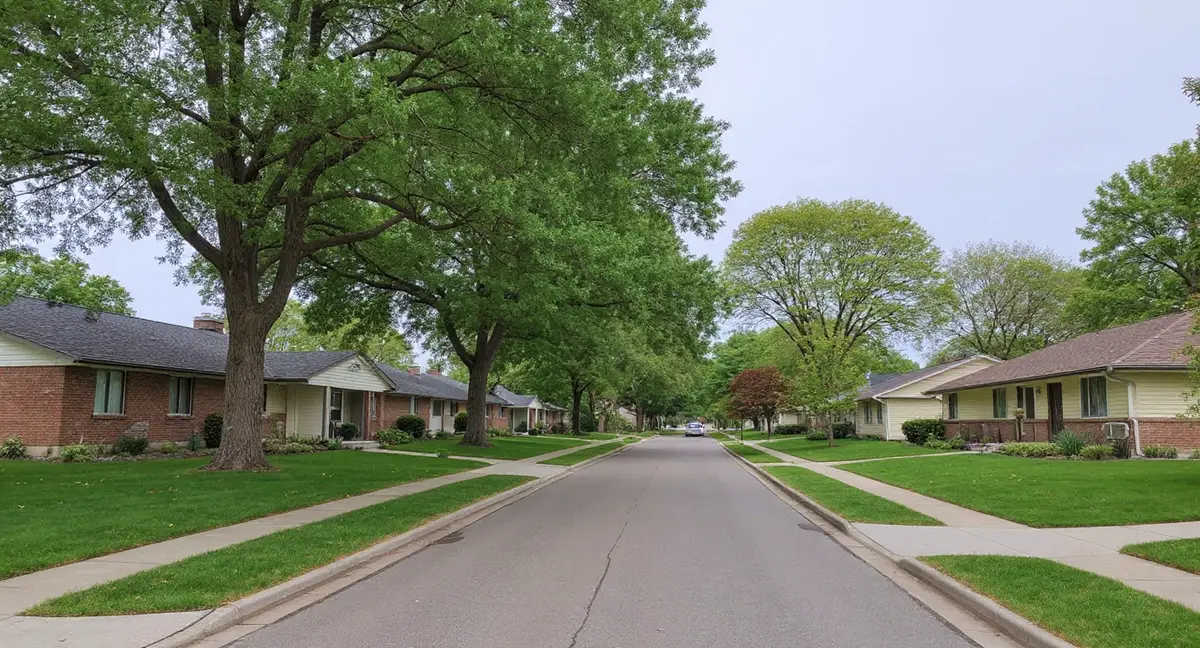
How Does Cass County's Prairie Clay Differ from Jackson County Soil?
Raymore sits on Cass County prairie-derived clay — a soil formed from centuries of weathered prairie grass organic matter over shale and limestone bedrock, distinct in both origin and behavior from the Wymore-Ladoga clay complex that dominates Jackson County to the north. Both soil types produce high shrink-swell potential. Both generate the volumetric changes that damage residential foundations. But they are classified separately by the USDA for good reason: the organic matter content in Cass County's prairie-derived clay gives it different moisture retention characteristics, different drainage timing, and a different relationship between rainfall events and peak expansion pressure against foundations.
Prairie-derived clay retains moisture in its upper profile longer than Wymore-Ladoga during the summer dry-down period, because the organic component acts as a sponge layer that resists rapid evaporation. This means the annual shrink-swell amplitude in Cass County is slightly compressed compared to Jackson County — the soil does not dry as deeply in summer, so the contraction phase is less dramatic. However, the expansion phase is still aggressive: when fall and spring rainfall recharges the profile, the clay swells with force sufficient to crack concrete, displace walls, and heave slabs. The foundation science page explains how even moderate shrink-swell amplitude, repeated over decades, produces cumulative structural damage.
Cass County's position on the southern fringe of the Kansas City metro means it sits on the geologic transition between the Kansas City area's glacial-influenced soils and the Ozark Plateau's residual clays to the south. This transitional position produces localized soil variation within Raymore itself — the clay profile is not perfectly uniform across the city. Western portions of Raymore, closer to the drainage influence of South Creek, may have slightly different soil moisture behavior than the drier upland sections along the I-49 corridor. Soil testing on individual lots, rather than reliance on county-level generalization, remains the most accurate predictor of site-specific foundation risk.
Missouri's frost depth of 36 inches applies uniformly across Cass County — footings must reach at least 36 inches below grade to remain below the frost line. In Raymore's prairie clay, the frost zone is particularly relevant because the organic-rich upper soil holds enough moisture to form ice lenses when temperatures drop below freezing. Ice lens formation within the frost zone pushes laterally and upward, adding seasonal mechanical force to the baseline shrink-swell cycle. Slabs and shallow footings that do not reach the 36-inch depth are exposed to this freeze-thaw action every winter.
What Construction Eras Shape Raymore's Foundation Vulnerability?
Raymore is overwhelmingly a post-1990 suburb — unlike Independence, Blue Springs, or even nearby Belton, Raymore has almost no pre-1980 housing stock, which means its entire residential base is relatively new construction on aggressive clay. The city's population grew from under 8,000 in 1990 to over 20,000 by 2010, a trajectory that placed thousands of homes on Cass County prairie clay in a compressed 20-year window. Foxwood, one of Raymore's earliest large subdivisions, represents the 1990s development wave: poured concrete basements and slab-on-grade homes built during a period when the southern metro was expanding rapidly along the I-49 corridor.
Post-2000 construction in Raymore shifted even more heavily toward slab-on-grade foundations — a construction method that is less expensive than full basements and became standard in the southern Kansas City metro's flat prairie terrain. Timber Creek, Eagle Creek, and the subdivisions east of I-49 are predominantly slab-on-grade. This construction type eliminates the basement wall vulnerability that dominates older Jackson County suburbs, but it introduces a different risk profile: the entire living surface sits directly on the clay, making it responsive to every expansion and contraction event. Sloping floors in slab-on-grade homes reflect direct soil movement beneath the living space, not transmitted stress from a failing basement wall below.
Raymore's rapid growth also means its infrastructure — storm drainage, subdivision grading, and lot-level drainage — was built in phases that do not always integrate smoothly. Early subdivisions designed their own internal drainage networks. Later adjacent development may have altered the drainage context around existing neighborhoods by raising grade on adjacent parcels, redirecting surface flow, or adding impervious surface area that concentrates runoff. A Foxwood homeowner whose lot drained well in 1998 may face different conditions after a 2006 subdivision was graded uphill from the original property line. These infrastructure-era mismatches are specific to growth suburbs and less common in established cities with mature, integrated drainage systems.
The practical consequence of Raymore's young housing stock is that most homes are still in the early-to-mid exposure window on Cass County clay — the period between 15 and 35 years when cumulative soil movement first becomes visually apparent. Homes built in the mid-1990s are now approaching 30 years and are beginning to show the first generation of observable symptoms. Homes built in 2005 or later have another decade before reaching that threshold. This timeline gives Raymore homeowners something that owners in older suburbs do not have: the opportunity to establish baseline measurements and implement drainage improvements before damage becomes structural. The homeowner guide covers practical monitoring techniques for catching early movement.
Which Symptoms Show Up First in Raymore's Housing Stock?
In Raymore's slab-on-grade homes, the first visible symptom is almost always cracked floor tile in kitchens and bathrooms — rigid materials that cannot flex with the slab and fracture when the underlying clay heaves or settles unevenly. A single cracked tile is cosmetic. A line of cracked tiles tracking across a room indicates that the slab beneath them has developed a differential elevation change along that line — one side higher or lower than the other. This is the slab responding to uneven clay movement below, and it is the earliest stage of a process that, if it continues, produces sticking doors, drywall cracks at corners, and measurable floor slope.
Garage floor cracking is disproportionately common in Raymore because garage slabs are typically thinner than house slabs, unreinforced or lightly reinforced, and poured on clay that receives less moisture management attention than the house perimeter. The garage slab sits on the same prairie clay as the rest of the foundation, but it often lacks the positive grading, gutter discharge management, and landscaping moisture control that homeowners maintain around the house itself. Driveways slope toward the garage, concentrating water at the slab edge. The result is accelerated wet-dry cycling on the garage slab relative to the house slab, producing garage floor sinking and cracking patterns that may appear years before the house foundation shows distress.
For the subset of Raymore homes with full basements — primarily in the older Foxwood-era construction — diagonal cracks at basement window corners are the diagnostic early symptom, following the same mechanical pattern as Jackson County suburbs but on Cass County clay. These diagonal cracks indicate differential settlement: one footing corner has dropped relative to another, racking the wall and producing a crack that runs at roughly 45 degrees from the window corner toward the nearest structural junction. The crack is typically wider at the top than at the bottom, indicating the upper portion of the wall has moved more than the lower. In Raymore's 1990s poured concrete walls, these cracks are still in early stages — narrow, often seasonally active, and responsive to moisture management improvements.
Exterior signs in Raymore subdivisions include separation between the garage slab and the house slab — a gap that opens at the expansion joint where the two structures meet. This separation occurs because the garage and house sit on independently poured slabs that respond to clay movement beneath them at different rates. A widening gap at this joint — visible as a crack in the driveway-to-house transition — indicates that the two structures are moving in different directions or at different magnitudes. It is common, it is cosmetic in early stages, but it indicates that the underlying clay is actively cycling.
A Raymore slab-on-grade home built in 2005 shows cracked floor tile in the kitchen tracking in a line across the room. What does this pattern most likely indicate about the Cass County prairie clay beneath the slab?
How Does the Seasonal Cycle Affect Raymore Foundations?
Raymore receives approximately 42 inches of rainfall annually, with the May peak of 5.7 inches driving the clay to maximum saturation and maximum expansion pressure — the period when slab heave, wall cracking, and door misalignment are at their worst. The April-through-June window is when prairie clay reaches full saturation in the upper profile. Because Cass County's organic-rich clay retains moisture longer than Wymore-Ladoga, the expansion phase in Raymore may persist slightly longer into early summer than in Jackson County suburbs. Symptoms that appear or worsen in May and June are almost certainly clay-cycle-driven.
The summer dry-down from July through September contracts the clay and relieves pressure — but in Raymore's prairie-derived soil, the contraction phase is less extreme than in Jackson County, meaning the annual pressure range is narrower. This compressed cycle sounds like good news, and in one sense it is: the peak forces are slightly lower. But a narrower cycle also means the clay spends more of the year in a partially expanded state, maintaining persistent low-level pressure against foundations rather than fully releasing in summer. Chronic low-level pressure can produce slow, progressive wall displacement that does not generate dramatic seasonal cracking but instead accumulates as gradual out-of-plumb drift over years.
Winter freeze-thaw within Missouri's 36-inch frost zone adds a secondary mechanical cycle to the baseline shrink-swell. When Raymore's moisture-retentive prairie clay freezes, the ice expansion within the soil generates lateral and upward forces independent of the clay's own volumetric behavior. Repeated freeze-thaw events through December, January, and February progressively wedge the soil, and each thaw cycle allows the expanded soil to reposition slightly before the next freeze locks it in place. The cumulative effect over a winter season is net soil displacement that does not fully reverse when temperatures rise. Slab-on-grade homes are particularly sensitive to this frost-zone action because the slab sits within the depth range where freeze-thaw forces are strongest.
What Can Raymore Homeowners Do Before Problems Start?
Raymore's relatively young housing stock gives its homeowners a genuine advantage: most homes have not yet accumulated enough clay-cycle damage to require structural repair, which means drainage and grading improvements made now can meaningfully extend the timeline before intervention is needed. Gutters that discharge at least six feet from the foundation, downspout extensions directed away from the house, and positive yard grading with a 6-inch drop over the first ten feet are the primary controls. In slab-on-grade construction, these measures are even more critical because there is no basement wall buffer between the soil and the living space — moisture management at the slab perimeter directly controls how much clay expansion occurs beneath the floor.
Monitoring slab elevation with a simple builder's level across the longest dimension of the house, recorded twice per year — once in September and once in May — provides the data needed to distinguish normal seasonal flex from progressive movement. A slab that varies by 1/4 inch between seasons but returns to the same September reading each year is cycling normally. A slab that shows progressively higher or lower readings each September is moving cumulatively, and that trend warrants professional evaluation. The repair cost page provides context on how early-stage polyjacking or slab pier installation compares financially to waiting until movement has progressed to the point where interior finishes are damaged.
For Raymore homes in subdivisions where adjacent development has altered drainage patterns, documenting water flow during heavy rainfall events identifies whether surface water is being directed toward the foundation from upgraded surrounding parcels. A video of the yard during a May rainstorm — showing where water pools, where it flows, and how quickly it clears — provides evidence that no dry-season inspection can replicate. If surface water from adjacent properties is concentrating at or near the foundation, grading corrections or French drain installation can redirect that flow before it saturates the clay beneath the slab. Addressing drainage changes caused by surrounding development is specific to growth suburbs like Raymore and is one of the most overlooked contributors to early foundation distress in newer communities.
- Raymore's Cass County prairie-derived clay retains moisture longer than Jackson County's Wymore-Ladoga, producing a compressed but persistent shrink-swell cycle with chronic low-level pressure against foundations.
- Slab-on-grade construction — dominant in post-2000 Raymore subdivisions — responds to clay movement from below, making cracked floor tile and garage floor separation the earliest visible indicators of soil movement.
- Most Raymore homes are still in the early exposure window (15-35 years), giving homeowners the opportunity to establish baseline measurements and improve drainage before damage becomes structural.
- Adjacent subdivision development can alter drainage patterns around existing homes — documenting water flow during heavy rainfall identifies whether surface water from newer construction is being directed toward the foundation.
Raymore Foundation Questions
How does Cass County prairie clay differ from the Wymore-Ladoga clay in Jackson County?
Both are high-shrink-swell clays, but they formed through different processes. Jackson County's Wymore-Ladoga is a montmorillonite-dominated clay complex mapped as a distinct USDA soil series with 60 to 80 percent clay content. Cass County's prairie-derived clay formed from weathered prairie grass organic matter over shale and limestone parent material. The organic content gives Cass County clay slightly different moisture retention characteristics — it tends to hold moisture longer in the upper profile during dry periods but drains more slowly once saturated. Both soils generate enough volumetric change to damage foundations, but the timing and amplitude of seasonal movement differ enough that repair strategies calibrated for Jackson County may need adjustment for Cass County conditions.
Are Raymore's newer homes safer from foundation problems than older Kansas City suburbs?
Newer construction benefits from updated building codes, improved concrete mix designs, and better waterproofing standards — but the soil does not care when the house was built. Raymore's post-1990 and post-2000 homes sit on the same Cass County prairie clay that has been cycling through wet and dry seasons for millennia. What changes with newer construction is the timeline: a home built in 2005 has experienced roughly 20 years of shrink-swell cycling, while a 1960s home in Independence has experienced over 60 years. Newer Raymore homes are in the early phase of their exposure window, when small cracks and minor floor irregularities are beginning to appear for the first time. These early indicators are not emergencies, but they are the starting point of a cumulative process.
Why is slab-on-grade construction common in Raymore and what does it mean for foundation risk?
Raymore's development occurred during a period when slab-on-grade construction gained popularity in the southern Kansas City metro — it is less expensive than full basements and well-suited to the relatively flat terrain of Cass County's prairie landscape. Slab-on-grade foundations sit directly on the clay surface rather than embedding below it, which means the entire slab is exposed to the shrink-swell cycle from below. When prairie clay expands, it pushes upward on the slab; when it contracts, the slab loses support. The result is differential heave and settlement that shows up as cracked floor tile, uneven flooring, and doors that bind seasonally. Slab problems are addressed differently than basement wall problems — polyjacking and slab piers are the primary methods rather than wall anchors or carbon fiber.
What foundation symptoms appear first in Raymore's 1990s-era subdivisions like Foxwood?
The earliest indicators in Raymore's 1990s subdivisions are typically cosmetic-level but structurally meaningful: hairline cracks in drywall at door and window corners on the first floor, minor seasonal sticking of exterior doors, and thin cracks in garage floor slabs. These symptoms emerge because 30-plus years of Cass County prairie clay cycling has accumulated enough differential movement to stress the structure at its weakest geometric points — corners of openings. In slab-on-grade homes, cracked floor tile in kitchens and bathrooms is often the first visible sign, because rigid tile shows movement that carpet and vinyl would absorb without visible distortion.
Does the I-49 corridor development pattern affect foundation risk in Raymore?
The I-49 and US-71 corridor drove Raymore's growth pattern, with subdivisions expanding outward from the highway interchange zone. Development along transportation corridors typically proceeds rapidly, which can mean that grading, soil preparation, and drainage infrastructure are built to minimum standards rather than optimized for long-term soil behavior. Rapid subdivision development on prairie clay also means large areas of previously undisturbed soil are stripped of vegetation and regraded in a short window, exposing the clay to moisture changes it had not experienced under established prairie grass cover. The transition from undisturbed prairie to residential subdivision resets the soil's moisture equilibrium, and the first 10 to 20 years after construction represent an adjustment period during which the clay establishes a new seasonal moisture baseline beneath the built environment.