Prairie Village, Kansas Foundation Risk Profile
Soil data, housing stock analysis, and seasonal risk patterns for Prairie Village — Johnson County's oldest suburb, where 1940s-1960s block basements meet aggressive clay soil with 70 to 80 years of cumulative exposure.
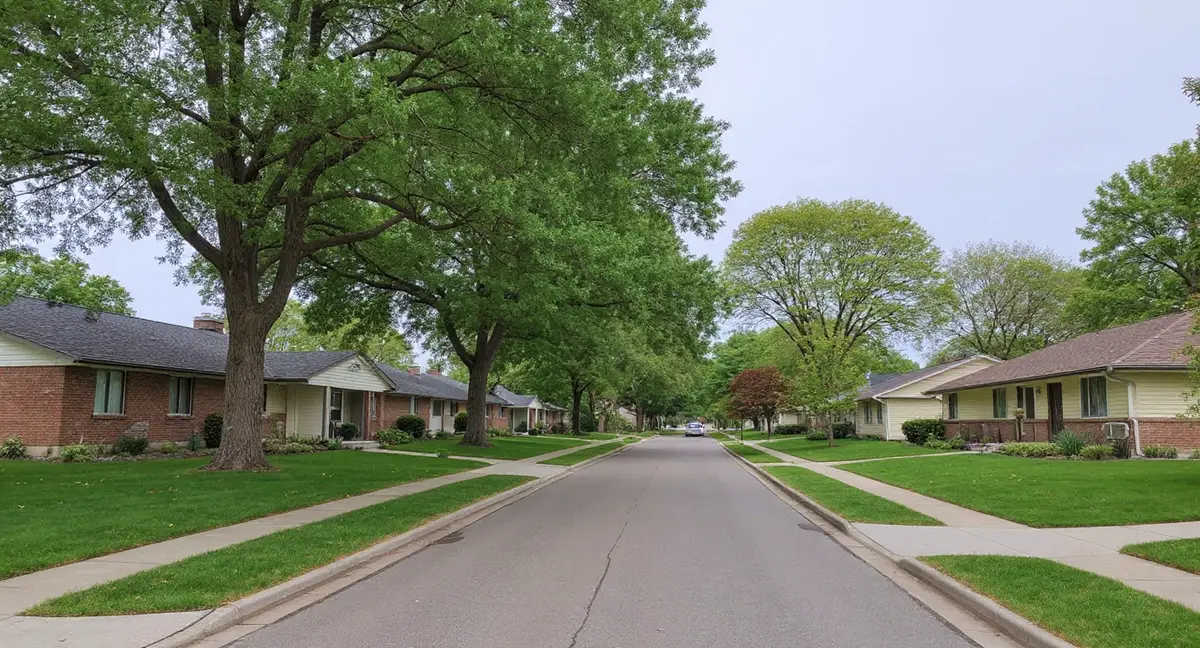
Prairie Village is Johnson County's oldest suburb, built almost entirely between the 1940s and 1960s, giving it the highest block-basement density in the county and 70 to 80 years of cumulative Wymore-Ladoga clay exposure. The city's signature Cape Cod homes concentrate more structural load over their foundations than ranch homes, accelerating differential settlement during summer clay contraction.
Why Does Prairie Village's Soil Put Foundations at Risk?
Prairie Village sits on the Wymore-Ladoga clay complex — the same montmorillonite formation that underlies all of Johnson County, with 60 to 80 percent clay content classified by the USDA as "very high" shrink-swell and assigned to Hydrologic Soil Group D, the lowest infiltration and highest runoff category. The clay expands when wet and contracts when dry, and the magnitude of that seasonal movement is large enough to crack, bow, and displace residential foundation walls over repeated annual cycles. Group D classification means rainwater sheds laterally across the surface rather than percolating downward, pooling against foundation walls and saturating the clay at footing depth before slowly evaporating during dry periods.
What separates Prairie Village from newer Johnson County suburbs is not the soil itself — it is how long the soil has been working against the foundations above it. A block basement wall built in 1948 has endured roughly 78 annual shrink-swell cycles on Wymore-Ladoga clay. The same soil formation beneath a 1995 home in western Overland Park has completed roughly 31 cycles against that foundation. Cumulative clay exposure is a compounding variable: each cycle widens existing microfractures in mortar joints and block faces, and the damage does not reverse when the clay returns to its resting state. The foundation science page covers how montmorillonite clay generates lateral earth pressure against basement walls.
Indian Creek and Tomahawk Creek are the primary drainage features running through Prairie Village, and both create corridors of elevated soil moisture that modify the standard clay behavior for adjacent homes. Prairie Village sits downstream on Indian Creek from Overland Park, collecting the accumulated stormwater volume from the entire upstream watershed. Homes within the creek corridors experience higher baseline soil moisture, greater hydrostatic pressure against basement walls during rain events, and a wider seasonal swing between wet and dry soil states. The Tomahawk Creek Prairie Village reach adds a second drainage corridor affecting the southern and western portions of the city.
The frost depth in the Kansas City metro is 36 inches, meaning seasonal freeze-thaw cycling penetrates three feet below grade and reaches the upper portions of most basement walls and all shallow footings. Ice formation inside existing cracks expands their volume by approximately 9 percent with each freeze event, widening cracks that the clay's shrink-swell has already initiated. For Prairie Village's 1940s-era foundations, which have accumulated decades of clay-driven cracking, freeze-thaw acts as an accelerant on pre-existing damage rather than a primary cause.
How Does Prairie Village's Construction History Shape Foundation Vulnerability?
Prairie Village is a J.C. Nichols planned community — one of the earliest planned suburban developments in the United States — built almost entirely between the 1940s and 1960s, making it the oldest residential suburb in Johnson County by a wide margin. The J.C. Nichols Company developed Prairie Village as a continuation of the planned community approach that produced the Country Club District in Kansas City, Missouri, applying deed restrictions, uniform setbacks, and consistent architectural styles across thousands of residential lots. The housing stock is overwhelmingly Cape Cod and ranch designs with full block basements, reflecting the construction norms of the postwar era.
The practical consequence of this development history is that Prairie Village has the single highest concentration of concrete block basement walls in Johnson County. By the time Overland Park, Olathe, and Lenexa experienced their main residential booms in the 1970s through 2000s, poured concrete had replaced block as the standard basement wall material. Prairie Village never went through that transition because the city was already fully built out. Block walls are more vulnerable to stair-step cracking through mortar joints and to inward bowing from lateral clay pressure than poured concrete, because the mortar joints create planes of weakness that a monolithic pour does not have.
Cape Cod homes — the signature Prairie Village housing type — present a specific foundation vulnerability that single-story ranches do not share. The 1.5-story Cape Cod design places second-floor living space above the same foundation footprint as a single-story structure, increasing the bearing load on the clay below. When the Wymore-Ladoga formation contracts during summer drought, the heavier Cape Cod structure settles more aggressively into the bearing voids left by shrinking soil than a lighter ranch on an identical foundation. This load differential makes Cape Cod foundations more prone to differential settlement, which manifests as sloping floors and sticking doors and windows in the finished living space.
Prairie Village is fully built out with essentially zero new construction — a characteristic it shares with only a few other inner-ring Johnson County suburbs. Every residential lot in the city carries a foundation that is at minimum 60 years old. There are no new subdivisions introducing modern foundation engineering into the housing inventory, no recent soil reports being generated for construction permits, and no fresh data on current soil conditions from excavation activity. The city's foundation stock is a closed population aging uniformly on the same aggressive clay.
Why are Cape Cod homes in Prairie Village more prone to differential settlement than single-story ranch homes on the same Wymore-Ladoga clay?
Which Prairie Village Neighborhoods Face the Highest Foundation Risk?
The Mission Hills-adjacent areas along Prairie Village's western edge contain some of the city's earliest construction — late 1940s homes that now carry 75 to 80 years of cumulative Wymore-Ladoga clay exposure. These properties sit at the highest elevation within Prairie Village and benefit from better natural drainage than the creek-corridor neighborhoods, but the sheer duration of clay exposure has driven cumulative damage into the block walls regardless. Mortar joints in block basements from this era used a lime-heavy mix that has calcified and become brittle, making the joints less able to absorb ongoing clay-driven movement without cracking.
The Corinth area and Meadowbrook neighborhood in central Prairie Village occupy relatively flat terrain between the Indian Creek and Tomahawk Creek drainage corridors, creating a zone where surface water drains slowly and soil moisture remains elevated for extended periods after rain events. Group D soil in flat terrain is a particularly unfavorable combination because the water has no gradient to follow away from foundations — it simply sits in the clay until evaporation removes it. Block basements in these central neighborhoods are more likely to show horizontal cracking from sustained lateral pressure than the better-drained hillside properties along the western edge.
Tomahawk Ridge, in the southern portion of Prairie Village, sits along the Tomahawk Creek corridor and faces the combined risk of creek-driven soil saturation and clay shrink-swell. Homes near Tomahawk Creek experience baseline soil moisture conditions similar to the Indian Creek corridor properties, with the added variable that Tomahawk Creek's drainage basin includes portions of the adjacent commercial development along its path. Impervious commercial surfaces generate faster, higher-volume runoff than residential yards, meaning Tomahawk Creek can rise quickly during storms and push saturated conditions outward into the residential soil faster than Indian Creek's primarily residential watershed.
Prairie Fields, in the eastern portion of the city, contains 1950s and early 1960s housing that sits on terrain sloping gently toward Indian Creek. The eastward slope means these properties shed surface water relatively effectively, but the subsurface drainage still moves toward the creek, maintaining a moisture gradient through the clay beneath foundations. Homes on the downhill side of any east-facing slope in Prairie Fields receive subsurface moisture flow from uphill properties, creating asymmetric soil conditions around the foundation perimeter — wetter on the uphill side, drier on the downhill side — that drive differential settlement. The cost page documents how differential settlement repair costs scale with the degree of elevation difference across the foundation.
What Foundation Damage Patterns Define Prairie Village?
Stair-step cracking through block wall mortar joints is the single most prevalent foundation damage pattern in Prairie Village, appearing in a higher percentage of homes than in any other Johnson County suburb because of the city's unmatched block-basement density and advanced cumulative clay exposure. The crack follows the path of least resistance through the mortar rather than through the block itself, tracing a diagonal or stepped pattern from the wall's lower courses toward upper corners. In Prairie Village's oldest stock, multiple stair-step cracks may be present in a single wall segment, indicating the wall has accommodated repeated differential movements across multiple decades of clay cycling.
Inward wall bowing — where the entire block wall has displaced inward from its original plane — is the more advanced expression of the same lateral clay pressure that produces stair-step cracks, and Prairie Village's housing age means this advanced condition is more common here than in younger suburbs. A block wall that has bowed inward more than one inch at mid-height has exceeded the threshold where monitoring alone is sufficient and requires structural intervention. Stabilization options include carbon fiber straps for walls with moderate displacement and wall anchors for walls with more advanced movement. The choice depends on the magnitude of displacement and whether the wall needs to be held in place or actively pushed back toward its original position.
Differential settlement manifesting as sloping floors, racked door frames, and diagonal cracks in drywall above grade is common across all Prairie Village neighborhoods but particularly pronounced in Cape Cod homes where the second-floor load amplifies settlement under clay contraction. The settlement pattern typically shows the south-facing and west-facing portions of the foundation settling more than the north-facing side, because those exposures lose soil moisture fastest during summer heat and the clay beneath them contracts first. This creates a directional tilt that worsens incrementally over successive dry seasons.
Chimney separation from the main structure is a damage pattern seen in Prairie Village's older homes that is less common in newer suburbs simply because many newer homes do not have masonry chimneys. A chimney founded on its own footing settles independently from the house foundation, and the differential movement between the two produces a visible gap where the chimney pulls away from the exterior wall. Chimney separation is both a structural concern and a water infiltration pathway — the gap allows rain to enter the wall cavity and accelerate deterioration of the adjacent block basement wall.
When Should Prairie Village Homeowners Watch for Foundation Movement?
The highest-risk period for Prairie Village foundations is May through early June, when Johnson County's peak monthly rainfall of 5.7 inches saturates the Wymore-Ladoga clay to full expansion and generates maximum lateral pressure against basement walls. Block walls that were stable through winter may show new stair-step cracks or visible displacement after a wet May, as the expanding clay pushes with force that exceeds what the mortar joints can resist. Creek-corridor homes along Indian Creek and Tomahawk Creek enter this high-risk window slightly earlier — late April — because creek recharge begins saturating adjacent soil before peak rainfall arrives.
The secondary high-risk window runs from late July through September, when summer heat and reduced rainfall dry the clay and remove bearing support from footings. This is when differential settlement advances most aggressively in Cape Cod homes, where the heavier structural load drops into the voids left by contracting clay. Floors that were level in May may show measurable slope by September. Doors that opened freely during spring may begin binding in their frames as the foundation racks under asymmetric settlement. The 42-inch annual rainfall drops to its seasonal minimum during this period, and the clay can contract several inches in severe drought years.
The transition months of March-April and September-October are the best inspection windows because the soil is actively changing states, making any foundation movement detectable through simple crack monitoring. Photograph existing cracks with a ruler for scale at the start of each transition period. Cracks that widen measurably between spring and fall readings confirm active movement. For Prairie Village homeowners evaluating whether to pursue push pier installation or wall stabilization, two to three seasons of documented crack progression provides the data needed to scope the repair accurately. The homeowner's guide includes a crack monitoring protocol organized by foundation type.
How Can Prairie Village Homeowners Slow Foundation Damage?
Soil moisture management around the foundation perimeter is the single most effective prevention measure available to Prairie Village homeowners, and it costs nothing beyond water and attention. The goal is to reduce the amplitude of the seasonal wet-dry swing the clay experiences at footing depth. During dry summer months, consistent low-volume irrigation along the foundation perimeter — a soaker hose running 30 minutes every few days — prevents the clay from contracting fully away from the footing. The objective is not to saturate the soil but to maintain a baseline moisture level that limits the contraction phase.
Prairie Village's fully built-out character creates a drainage situation where neighboring properties' grading decisions directly affect your foundation's moisture exposure. In newer subdivisions, lot grading is engineered as part of the development plan. In Prairie Village's 1940s-1960s neighborhoods, decades of landscaping changes, patio additions, and driveway resurfacing have altered the original grading in ways that may direct water toward — rather than away from — adjacent foundations. Positive grading of at least six inches of fall over ten feet away from the foundation wall is the minimum standard. Where the neighbor's yard slopes toward your foundation, a French drain or swale along the property line may be the only practical solution.
Gutter and downspout maintenance is disproportionately important in Prairie Village because the mature tree canopy — a hallmark of the J.C. Nichols planned landscape — fills gutters rapidly during fall and spring. Clogged gutters overflow at the foundation wall, dumping concentrated water directly against the clay. Downspout extensions carrying discharge at least six feet from the foundation are essential. Prairie Village's older homes frequently have original clay tile drain systems that may be partially collapsed or root-infiltrated after 70 years, meaning the designed drainage path may no longer function and surface management becomes the primary line of defense.
For homes showing active crack progression, the window between detection and structural intervention is not unlimited — block walls that have displaced more than one inch inward require stabilization before additional clay cycles drive further movement. The difference between a wall that can be stabilized with carbon fiber straps and one that requires full wall replacement is often a matter of two or three additional seasons of unaddressed movement. Early documentation and timely evaluation prevent manageable repairs from escalating into major structural projects.
- Prairie Village is Johnson County's oldest suburb (1940s-1960s), with the highest block-basement density in the county and 70-80 years of cumulative Wymore-Ladoga clay exposure on every residential lot.
- Cape Cod homes — the signature Prairie Village housing type — settle more aggressively than ranch homes during clay contraction because they concentrate more structural load over the same foundation footprint.
- The city is fully built out with zero new construction, meaning the foundation stock is a closed population aging uniformly on aggressive clay with no modern engineering entering the inventory.
- Soil moisture management during dry summer months — a soaker hose along the foundation perimeter — prevents the clay from contracting fully away from the footing and limits the amplitude of seasonal damage.
Prairie Village Foundation Questions
Why does Prairie Village have more block basements than any other Johnson County suburb?
Prairie Village was developed almost entirely between the 1940s and 1960s — a period when concrete block was the standard basement wall material for residential construction across the Kansas City metro. Suburbs like Overland Park and Olathe expanded primarily in the 1970s through 2000s, when poured concrete had replaced block as the dominant method. Because Prairie Village is fully built out with virtually zero new construction, the city never received the later-era poured concrete homes that dilute the block basement percentage in larger suburbs. The result is the highest block-basement density of any Johnson County suburb.
Are Cape Cod homes in Prairie Village at greater foundation risk than ranch-style homes?
Cape Cod homes concentrate more structural load over a smaller footprint than single-story ranch homes, because the second-floor living space adds weight to the same foundation dimensions. On Wymore-Ladoga clay, this additional bearing load accelerates differential settlement when the clay contracts during dry periods — the heavier structure sinks more aggressively into the voids left by shrinking soil. Cape Cods also have smaller attic spaces and often limited ventilation, which can trap moisture above the living envelope and contribute to condensation issues that migrate downward into basement walls.
How does Indian Creek affect foundation risk in Prairie Village compared to Overland Park?
Prairie Village sits downstream on Indian Creek from Overland Park, meaning it receives the accumulated runoff volume from the entire upstream watershed. During heavy rain events, the creek's water surface elevation is higher in Prairie Village than at comparable distances from the channel in upstream Overland Park communities. This elevated flood stage translates to higher hydrostatic pressure against foundations within the creek corridor and a wider zone of saturated soil extending outward from the channel banks. Tomahawk Creek, which joins Indian Creek within Prairie Village, adds a second drainage corridor with overlapping flood influence zones.
What foundation repair methods are most commonly used in Prairie Village?
Prairie Village's 1940s-1960s block basements most frequently require wall stabilization through carbon fiber straps or wall anchors to arrest inward bowing from lateral clay pressure. Where settlement has caused the foundation to drop unevenly, push piers or helical piers are used to lift and stabilize the footing. Crack injection addresses water infiltration through individual block wall cracks, though block walls with multiple active cracks may require a broader waterproofing approach. The specific method depends on whether the wall is primarily bowing inward from lateral pressure or dropping from bearing failure — two different mechanisms that require different engineering responses.
Does Prairie Village's fully built-out status affect how foundation problems progress over time?
Yes, in a meaningful way. Because Prairie Village has no vacant land and virtually no new construction, the neighborhood drainage patterns are fully established and unchanging — unlike suburbs still under development where grading, tree removal, and new impervious surfaces continuously alter water flow. This stability means that once a Prairie Village homeowner identifies and corrects their property's drainage issues, the fix tends to hold long-term because the surrounding landscape is not being modified. However, it also means that existing drainage problems in fully built-out blocks — where neighboring properties' grading directs water toward your foundation — are difficult to resolve without cooperation across property lines.