Grandview Foundation Risk — Heavy Jackson County Clay, Post-War Housing Stock, and the Economics of Repair
Soil mechanics, housing stock analysis, and seasonal risk data for Grandview, Missouri — a southern Jackson County suburb where 1950s-1970s construction on the metro's heaviest clay concentration produces foundation challenges compounded by the financial realities of a lower-value housing market.
Grandview combines two compounding risk factors: Jackson County's heaviest Wymore-Ladoga clay at its southern reach and a 1950s-1970s block basement housing stock that has accumulated 50 to 75 years of cumulative shrink-swell damage. Lower median home values amplify the economic burden of foundation repair, with a typical $12,000 repair representing 8 to 10 percent of property value compared to 3 to 4 percent in higher-value suburbs.
Why Is Grandview's Clay Among the Most Aggressive in the Kansas City Metro?
Grandview sits on the southern reach of Jackson County's Wymore-Ladoga clay complex — the same formation that underlies Lee's Summit, Blue Springs, and Independence, but at a concentration and depth profile that places it among the most volumetrically active soil in the metro area. Wymore-Ladoga is a montmorillonite-dominated clay with 60 to 80 percent clay content, rated "very high" shrink-swell potential by the USDA, and classified Hydrologic Soil Group D — the slowest-draining category. Every foundation in Grandview rests on or within this material, and every foundation in Grandview is subject to its seasonal expansion and contraction forces. The foundation science page provides the detailed mechanics of how montmorillonite clay generates force against residential structures.
What distinguishes Grandview's position within the Wymore-Ladoga belt is the combination of heavy clay concentration with a housing stock old enough to have accumulated maximum cumulative damage. Lee's Summit and Blue Springs sit on the same clay but have predominantly newer housing stock — 1970s through 2000s construction that has experienced fewer total shrink-swell cycles. Grandview's homes, concentrated in the 1950s through 1970s, have undergone 50 to 75 years of annual cycling on clay that generates among the highest volumetric change forces in the region. Duration of exposure multiplied by soil activity level determines cumulative damage — and Grandview carries high values on both variables.
The Blue River headwaters influence drainage patterns in western Grandview, where terrain slopes toward the river corridor and concentrates surface runoff in low-lying residential areas. Homes west of the I-49 corridor and toward the Blue River drainage experience soil moisture conditions that differ from the drier upland areas along Grandview Road and View High Drive. The river's drainage influence keeps western-side clay closer to field capacity for more of the year, extending the expansion phase and reducing the summer dry-down that would otherwise relieve pressure against foundations. This moisture asymmetry across the city means that two Grandview homes built in the same year, with the same construction type, can face meaningfully different foundation risk depending on their position relative to the Blue River drainage.
Missouri's frost depth of 36 inches is the code-required footing depth across Jackson County, but Grandview's 1950s and 1960s construction predates the consistent enforcement of this standard. Footings placed at 28 to 32 inches — within the frost zone — are vulnerable to ice lens formation that pushes upward on the footing every winter. In Grandview's Wymore-Ladoga clay, which enters winter carrying substantial moisture from fall rainfall, the frost heave potential is significant. A footing that heaves 1/4 inch each winter and does not fully return to its original position each spring accumulates vertical displacement over decades — a slow, persistent source of foundation movement that compounds the clay's lateral shrink-swell pressure.
What Construction Era Defines Grandview — and Why Does That Matter?
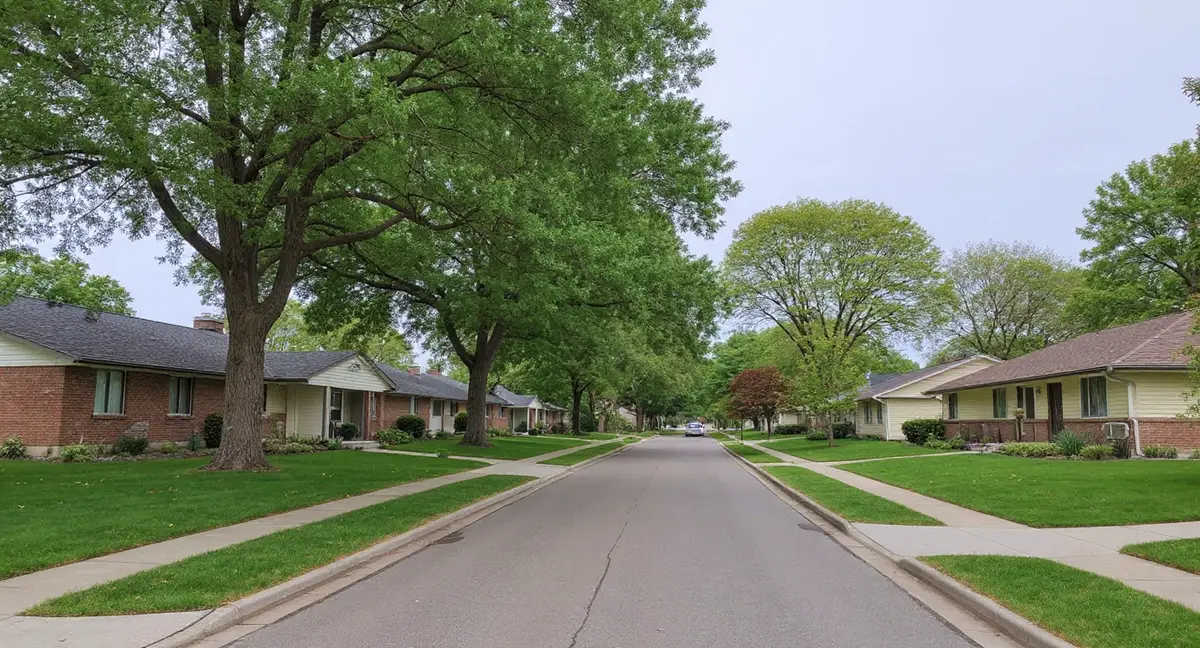
Grandview's residential fabric was built predominantly between 1950 and 1975, placing it in the post-war suburban expansion era when Kansas City's southern suburbs filled with modest ranch and split-level homes on concrete block basements. This construction era used block basement walls as the standard below-grade structural system. Block walls are assembled from individual masonry units bonded by mortar — a construction method that performs adequately under vertical loading but is inherently vulnerable to lateral pressure because every mortar joint is a potential failure plane. Grandview's block basements have been absorbing lateral pressure from Wymore-Ladoga clay for half a century or more.
The View High Drive corridor and the residential blocks between Grandview Road and I-49 contain the densest concentration of this 1950s-1970s housing stock — neighborhoods where nearly every home shares the same construction type, the same era, and the same clay exposure history. This uniformity creates a cohort effect similar to Blue Springs' 1970s-1980s cohort, but a generation older. Where Blue Springs is crossing the 40-to-50-year observation threshold now, Grandview's core housing stock crossed it 10 to 20 years ago. Many Grandview homes are already displaying intermediate-to-advanced symptoms: horizontal cracks at mid-wall height, measurable inward bow on basement walls, and floor slopes detectable without instruments.
Grandview has less post-2000 development than Raymore or southern Lee's Summit — the city was substantially built out before the 1990s growth wave that expanded the southern metro. This means Grandview lacks the buffer of newer, lower-risk construction that dilutes the risk profile of growth suburbs. The city's housing inventory is concentrated in a single era with a single dominant construction type on the metro's most aggressive clay. There is no newer development ring to balance the statistics. When evaluating Grandview's foundation risk at the city level, the numbers reflect block basements on Wymore-Ladoga clay at 50-plus years of exposure — and that combination produces one of the highest baseline risk profiles in the Kansas City area.
The smaller pockets of newer construction in Grandview — scattered infill development and a limited number of post-1990 subdivisions on the city's periphery — use poured concrete basements and some slab-on-grade construction. These newer homes face the same early-exposure-window risk as comparable construction in Raymore or Belton: sound structural systems in the first two decades of clay cycling, with first-generation symptoms beginning to appear in the 20-to-35-year range. But they represent a small fraction of Grandview's total housing stock. The city's foundation risk conversation is dominated by its post-war block basement majority.
Grandview's 1950s-1970s block basements show horizontal cracking at mid-wall height at higher rates than any other KC suburb. Why does this specific crack location indicate the wall's most critical structural failure point?
Which Foundation Failures Are Most Advanced in Grandview?
Horizontal cracking at mid-wall height on block basement walls is the most structurally significant pattern in Grandview — and it appears at higher rates here than in any other Kansas City suburb profiled in this atlas. A horizontal crack running through the mortar bed joint at approximately the same height as the exterior soil line indicates that the wall is bowing inward under sustained lateral pressure from the Wymore-Ladoga clay outside. In a block wall, this crack follows the weakest horizontal plane — the mortar joint — and it means the wall above the crack is being pushed inward relative to the wall below. This is not a cosmetic issue. It is the block wall failing at its most vulnerable point under the dominant lateral load that the soil applies.
Stair-step cracks at basement corners and window openings are the second most common failure pattern in Grandview's block basements, driven by differential settlement where one footing section drops more than an adjacent section. The crack follows the alternating bed-and-head joint path at roughly 45 degrees because the mortar joints are weaker than the block units. In Grandview, stair-step cracks are often wider than what a homeowner might see in a 30-year-old block wall — many of these cracks have been growing for decades, and crack widths of 1/4 inch to 1/2 inch at the widest point are not unusual in the city's oldest neighborhoods. At these widths, the crack has progressed well beyond seasonal cycling and indicates permanent structural displacement.
Sloping floors on the first story above the basement are a later-stage indicator that appears across Grandview's older housing stock with increasing frequency. When basement walls displace inward or footings settle differentially, the floor structure they support loses its level plane. A floor that slopes perceptibly across a room — detectable by placing a marble or level on the surface — indicates that the foundation below has changed geometry enough to transmit that displacement through the floor framing. In Grandview's ranch-style homes, where the first floor spans directly from basement wall to basement wall, floor slope tracks wall displacement almost directly. The slope may vary across the house, being more pronounced near the most displaced wall section.
Exterior indicators in Grandview include sticking doors and windows on frames that have racked as the foundation beneath them shifted, and visible gaps between brick veneer and window or door trim where the wall has moved but the rigid masonry has not followed. Grandview's 1950s-1970s homes often have brick veneer over the block basement and first-floor framing, and the veneer — tied to the wall structure but not structurally integrated with it — responds to foundation movement by separating at its weakest connections. A gap between the brick and a window frame that opens progressively over successive years is a direct visual indicator of ongoing wall movement. These exterior signs are visible from the sidewalk and provide a preliminary indication of which homes on a block have active foundation issues.
How Do Lower Property Values Change the Foundation Repair Equation in Grandview?
Grandview's median home values are lower than those in Lee's Summit, Blue Springs, and most Johnson County suburbs — and that economic reality makes foundation repair decisions more consequential per dollar of property value. A $12,000 wall anchor installation represents roughly 8 to 10 percent of a $140,000 Grandview home's value, compared to 3 to 4 percent of a $350,000 Lee's Summit home. The repair cost is the same — the engineering, materials, and labor do not change based on the home's market value — but the financial weight of that cost against the property's equity is substantially different. The repair cost page provides detailed data on method-specific pricing across the Kansas City metro.
This value-to-repair-cost ratio creates a painful decision point that is more acute in Grandview than in higher-value suburbs: repair now at significant relative cost, or defer and accept progressive damage. Deferral is not cost-neutral. A block wall that displaces an additional half-inch because repair was delayed a year may require active straightening in addition to stabilization — roughly doubling the project scope. A footing that settles another quarter-inch may require push piers to stabilize where an earlier intervention might have addressed the issue with drainage improvements and monitoring alone. The economics of deferral almost always favor early action, even when the upfront cost feels disproportionate to the home's value.
For Grandview homeowners evaluating whether to repair before selling, the math is straightforward: unrepaired foundation problems reduce sale price by more than the cost of repair in nearly every case. A home with a disclosed foundation issue — visible wall displacement, documented cracking, floor slope — sells at a discount that exceeds the repair cost, because buyers price in uncertainty, future repair cost escalation, and the inconvenience of managing a contractor after purchase. A home with a completed, warrantied repair sells at the repaired market value minus a modest discount for the history. The difference between those two outcomes typically exceeds the repair cost by a significant margin, making pre-sale repair financially rational even in a lower-value market.
What Steps Make the Biggest Difference for Grandview Homeowners?
For Grandview homeowners with block basements showing early-stage cracking — hairline stair-step patterns, minor seasonal sticking of doors — aggressive drainage management is the single most impactful action available. Gutters that discharge at least six feet from the foundation, downspout extensions pointed away from the house, and positive yard grading with a minimum 6-inch drop over the first ten feet reduce the volume of water reaching the Wymore-Ladoga clay adjacent to the wall. Reducing moisture input reduces the expansion pressure that drives the wall inward. In Grandview's older neighborhoods, where original grading has settled and may now slope toward the house, re-establishing positive grade can measurably reduce seasonal wall pressure.
Monitoring crack width and wall position twice per year — September at minimum clay expansion and May at maximum — provides the objective data needed to distinguish seasonal cycling from progressive displacement. A crack that opens every May and returns to its September width is responding to the clay cycle. A crack that is wider each successive September is progressing independently of the season — and that progression will continue until the underlying cause is addressed. In Grandview, where many block walls have been cycling for decades, the difference between "still cycling normally" and "progressing beyond seasonal bounds" determines whether the wall needs monitoring or intervention. Simple measurements with a crack gauge, recorded consistently, provide that answer.
Grandview homeowners whose block walls show horizontal cracking at mid-height with any visible inward bow should prioritize professional evaluation over continued monitoring — this specific combination of symptoms indicates active lateral displacement that drainage management alone cannot reverse. Carbon fiber straps bonded to the interior wall surface can arrest further inward movement when displacement is less than approximately one inch. Wall anchors extending through the wall into stable soil beyond the active clay zone provide resistance and, in some cases, can gradually return the wall toward its original position over successive tightening cycles. Both methods are most effective and least expensive when applied before displacement has progressed to the point where the wall requires excavation and reconstruction from the exterior.
- Grandview's 1950s-1970s block basements on the metro's heaviest Wymore-Ladoga clay have accumulated 50 to 75 years of cumulative damage — horizontal cracking at mid-wall height appears here at higher rates than in any other profiled suburb.
- Western Grandview homes near the Blue River headwaters face extended clay saturation and more aggressive expansion pressure than drier upland areas along View High Drive.
- Early intervention is financially critical: a wall anchor installation before significant displacement costs roughly half of what the same repair costs after the wall has displaced an inch or more and requires active straightening.
- Foundation problems reduce sale price by more than the repair cost in virtually every case — pre-sale repair is financially rational even in Grandview's lower-value housing market.
Grandview Foundation Questions
Why does Grandview have more severe foundation problems than Lee's Summit or Blue Springs?
Grandview's housing stock is predominantly older than both Lee's Summit and Blue Springs — concentrated in the 1950s through 1970s, when block basement construction was common and building codes did not account for long-term clay behavior. These homes have been cycling on Jackson County Wymore-Ladoga clay for 50 to 75 years, accumulating more damage than the 1980s-2000s construction that dominates Lee's Summit and Blue Springs. Additionally, Grandview's block basement walls are inherently more vulnerable to lateral clay pressure than the poured concrete walls used in later construction eras. The combination of older construction methods and longer clay exposure produces more advanced distress in Grandview than in suburbs with newer housing stock on the same soil.
Does the Blue River affect foundation risk in western Grandview?
The Blue River's headwaters influence drainage conditions in western portions of Grandview, where the terrain slopes toward the river corridor and surface runoff concentrates in low-lying areas. Homes near the Blue River drainage path sit on clay that receives additional moisture from concentrated surface flow, keeping the Wymore-Ladoga soil in those zones closer to saturation for longer periods after rainfall. This extended moisture contact amplifies the expansion phase of the shrink-swell cycle and increases lateral pressure against basement walls. Homes on the western drainage slope also face the risk of seasonal water table elevation changes tied to the river's flow volume — a factor that is independent of the clay's own moisture absorption behavior.
How does I-49 dividing Grandview affect foundation risk on either side?
I-49 and US-71 running through Grandview create a physical corridor of disturbed soil — the highway construction involved deep excavation, fill placement, and drainage rerouting that altered the natural clay profile along the highway's path. Homes immediately adjacent to the highway corridor may sit on fill soil or regraded clay that behaves differently from undisturbed Wymore-Ladoga further from the road. The highway also acts as a drainage divide: surface water on each side flows away from the highway rather than crossing it, which can concentrate moisture on the downslope side of adjacent properties. These highway-adjacent effects diminish within a few hundred feet of the corridor, but they are relevant for homes on lots that border the highway right-of-way.
Is foundation repair financially viable for lower-value Grandview homes?
This is the central economic question for many Grandview homeowners. When a foundation repair costs 8,000 to 15,000 dollars on a home valued at 120,000 to 160,000 dollars, the repair represents a much larger percentage of property value than the same repair on a 350,000-dollar Lee's Summit home. However, foundation problems that go unaddressed do not stabilize — they worsen, and the repair cost increases as damage progresses. A wall anchor installation at early displacement may cost half of what the same repair costs after the wall has displaced an inch or more and requires active straightening. Early intervention, even when the percentage-of-value math feels uncomfortable, is almost always less expensive than waiting.
What should a Grandview homebuyer look for during a pre-purchase inspection?
A pre-purchase inspection in Grandview should specifically examine all basement walls for horizontal cracks at mid-height, stair-step cracks at corners and window openings, and any visible inward bow or displacement. The inspector should check whether exterior doors and windows operate smoothly or bind, whether floors slope noticeably in any direction, and whether the garage floor has separated from the house slab. On a 1960s block basement in Grandview, these checks are not optional extras — they are the primary structural evaluation. A general home inspection may note visible cracks but lack the context to assess whether those cracks represent normal aging or active structural displacement on Wymore-Ladoga clay. A foundation-specific evaluation by a structural engineer or experienced foundation contractor provides that context.