Gladstone Foundation Risk — Mature Clay County Suburb, Loess-Clay Soil, and Decades of Block Basement Wear
Soil mechanics, housing stock analysis, and seasonal risk data for Gladstone, Missouri — a fully built-out 1950s-1970s northland suburb where five to seven decades of Clay County soil cycling have produced widespread block basement distress.
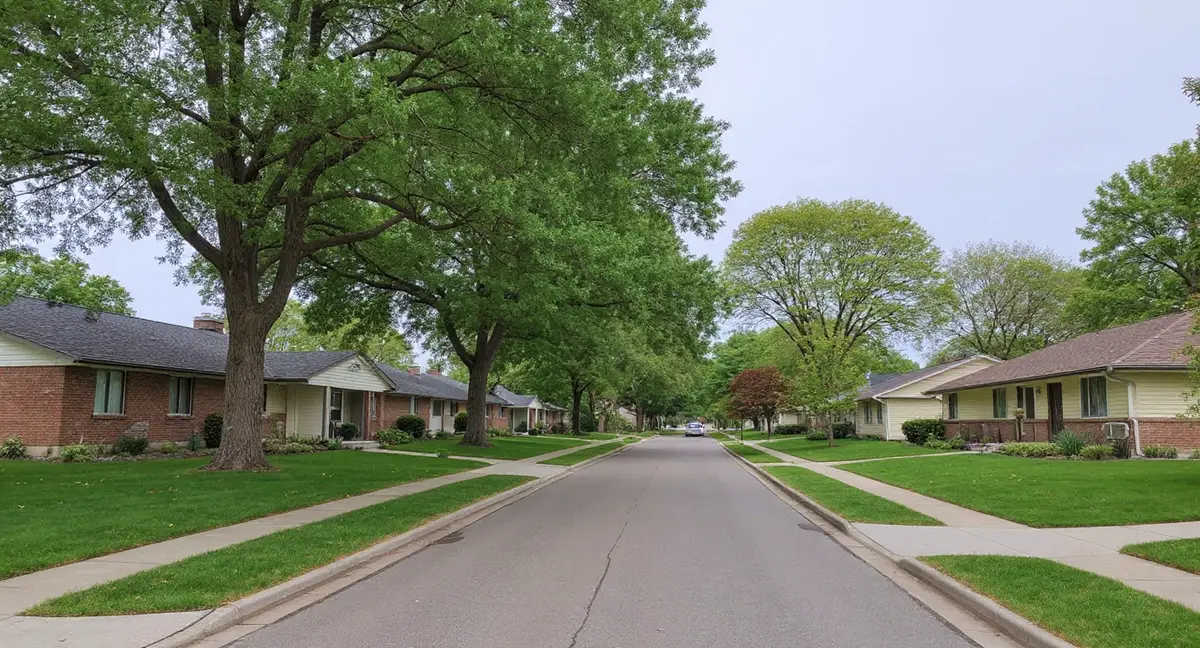
Gladstone is a single-era suburb built almost entirely between 1955 and 1975, where five to seven decades of Clay County loess-over-clay soil cycling have produced widespread block basement distress across the city. The loess-moderated clay produces smaller individual soil movements than Jackson County's pure Wymore-Ladoga, but the cumulative displacement from thousands of moderate cycles over 50-plus years equals or exceeds the damage from fewer extreme cycles.
What Makes Gladstone's Loess-Over-Clay Soil Different from Jackson County?
Gladstone sits on Clay County's characteristic hybrid soil — loess silt overlying weathered residual clay — a profile that behaves differently from the nearly pure Wymore-Ladoga montmorillonite that dominates Jackson County suburbs like Independence and Lee's Summit. The loess layer in Gladstone is a Pleistocene-era windblown silt deposit that blankets the underlying clay at varying thickness. Where Jackson County soil is 60 to 80 percent clay content and rates "very high" on the shrink-swell scale, Gladstone's soil profile is moderated by the silt fraction — still capable of shrink-swell movement, but with lower peak amplitude than pure montmorillonite.
The moderated shrink-swell behavior does not mean Gladstone foundations face less total risk — it means they face a different kind of risk distributed over a longer timeline. Jackson County's extreme clay produces dramatic seasonal movement that can crack a new foundation within its first decade. Gladstone's gentler clay-loess mix produces smaller individual movements, but those movements accumulate relentlessly over the 50 to 70 years that Gladstone's housing stock has been in the ground. The cumulative displacement from thousands of moderate cycles can equal or exceed the damage from fewer extreme cycles. The foundation science page explains how cyclic soil loading produces progressive structural displacement.
Clay County loess also introduces collapse potential — a failure mode that pure clay soils do not produce. Loess grains are held in an open, porous structure by weak capillary bonds. When water saturates the loess, those bonds dissolve and the soil compresses suddenly. In Gladstone, decades of development and surface water infiltration have partially consolidated the shallow loess, but deeper loess layers beneath footings may retain collapse potential. A plumbing leak that delivers sustained water into the soil directly beneath a footing can trigger localized collapse settlement even in long-developed neighborhoods.
Missouri's frost depth of 36 inches sets the minimum footing depth for Gladstone construction, placing footings below the frost line and below the most active shrink-swell zone. Most of Gladstone's 1950s-1970s construction meets or approximates this standard, but variations in actual footing depth across thousands of individually built homes mean some footings are shallower than intended. A footing placed several inches above the required 36-inch depth is exposed to both frost heave from ice lens formation and greater amplitude clay cycling — a combination that accelerates block wall displacement.
What Does a Fully Built-Out 1950s–1970s Suburb Look Like After Decades of Soil Pressure?
Gladstone is essentially a single-era suburb — the overwhelming majority of its residential inventory was constructed between approximately 1955 and 1975, creating a city where nearly every home has been exposed to roughly the same duration of Clay County soil cycling. This uniformity is unusual in the Kansas City metro, where most suburbs span multiple development eras. In Gladstone, the housing stock entered the soil environment together, aged together, and is now collectively reaching the 50-to-70-year threshold where cumulative block wall distress becomes visually apparent and structurally significant across entire neighborhoods.
Concrete masonry unit block construction dominates Gladstone's basement inventory — the standard method during the era when Gladstone was built and the most vulnerable common wall type to lateral soil pressure. Block walls fail at mortar joints because mortar is weaker in tension than the block units. Under lateral pressure from expanding clay, the wall bends inward, and the mortar on the tension side (inside face) cracks first. The resulting horizontal crack typically appears four to five courses above the basement floor — the point of maximum bending stress in a wall restrained at both top and bottom. This is the signature Gladstone foundation symptom, visible in hundreds of homes across the city.
The N Oak Trafficway corridor through central Gladstone, the Linden neighborhood, and the Englewood area all share the same block-on-clay-loess combination, with local variation driven by terrain and drainage rather than construction method or soil type. Homes at lower elevations and near drainage channels in the Happy Rock Park area receive more soil moisture input than ridge-top homes along N Oak. That moisture difference translates to different lateral pressure intensity against the same type of block wall. A block basement on a low lot near Happy Rock may show horizontal cracking at 40 years of age while an identical block basement on a high lot along N Oak remains crack-free until 55 or 60 years — same wall, same soil series, different moisture loading.
Gladstone's compact land area and dense residential street grid mean there is little undeveloped land to absorb runoff, and impervious surface coverage is high relative to newer, more spread-out suburbs. Driveways, streets, and rooftops shed water rapidly into the soil at their edges — the exact locations where foundations sit. This concentration of surface runoff at foundation perimeters is a chronic loading condition that compounds the natural rainfall-driven soil cycle. The foundation cracks overview describes how to interpret the crack patterns that result from sustained lateral loading on block walls.
Gladstone's loess-over-clay soil produces smaller individual shrink-swell movements than Jackson County's pure Wymore-Ladoga. Why have Gladstone's block basements still accumulated severe damage after 50 to 70 years?
What Does 50 Years of Cumulative Soil Damage Actually Look Like in Gladstone Homes?
The most common condition in Gladstone's block basements is a horizontal crack at the fourth or fifth course above the floor, running the length of the longest wall, with measurable inward deflection of the wall above the crack. This is not a cosmetic issue. The wall has permanently displaced inward — typically between 1/4 inch and 1 inch by the time the homeowner notices it — and the crack represents the hinge point where the wall is folding. Above the crack, the wall leans inward; below it, the footing holds the base in position. Each wet season adds a small increment to the total inward displacement, and the rate of additional movement tends to increase as the wall geometry changes.
Stair-step cracking at basement corners is the second most common pattern in Gladstone — the signature of differential settlement interacting with lateral pressure. When one corner of the foundation settles slightly relative to adjacent corners, the resulting stress concentrates at the wall intersection and propagates through the mortar joints at a 45-degree angle. In a block wall, this crack follows the stair-step pattern of alternating bed and head joints. The stair-step cracks page explains how crack width, direction, and location indicate whether the driving force is settlement, lateral pressure, or both.
First-floor symptoms in Gladstone homes — sticking doors, cracked drywall at door and window corners, and measurable floor slope — indicate that basement wall displacement has propagated into the frame above. A block wall that has deflected 1/2 inch inward at its midpoint changes the bearing geometry for the floor joists and sill plate resting on top of it. The floor system tilts toward the displaced wall, the door frames rack out of square, and the drywall — which cannot accommodate racking — cracks at stress concentrations. Sticking doors and windows that worsen during wet months and improve slightly during dry months are tracking the seasonal clay expansion cycle through the wall and into the frame.
Chimney separation is a less common but structurally significant symptom in Gladstone's older homes — especially those with exterior masonry chimneys built on independent footings. The chimney footing and the house footing settle at different rates because they carry different loads and often sit on slightly different soil conditions. Over decades, the gap between chimney and house wall widens, and the flashing joint fails — introducing water into the wall cavity and accelerating deterioration of both the chimney mortar and the house framing at the connection point. The chimney separation page covers the structural implications and the point at which separation warrants repair versus monitoring.
When Does Clay County's Wet-Dry Cycle Hit Gladstone Foundations Hardest?
Gladstone's peak foundation stress occurs between April and June, when spring rainfall saturates the clay-loess soil and drives the clay fraction to maximum expansion — pressing outward against block basement walls that have already accumulated decades of displacement. May is the wettest month, delivering over 5 inches of rainfall to soil that is already near field capacity from April's rain and snowmelt. The lateral pressure against a block wall peaks during this window, and any wall that is near its structural limit from cumulative displacement is most likely to crack or deflect further during the May-June saturation period.
The December-through-February freeze-thaw cycle adds frost action to the seasonal stress on Gladstone's block walls — and frost action on already-displaced walls is more damaging than frost action on walls that are still plumb. When moist soil freezes within Missouri's 36-inch frost zone, ice lenses form and push laterally against the wall. A plumb wall distributes this force evenly. A wall that has already deflected inward receives the frost force asymmetrically — more pressure on the upper portion that has moved inward, less on the lower portion held by the footing — which accelerates the bending pattern that the shrink-swell cycle initiated. Repeated freeze-thaw events through the winter incrementally worsen the displacement.
Gladstone's dense residential development and high impervious surface coverage mean that rainfall reaches the soil at foundation perimeters faster than in more spread-out suburbs with larger lots and more permeable ground cover. A 1-inch rainfall event on a Gladstone lot with a large driveway, sidewalks on two sides, and a small yard delivers a concentrated volume of water to the soil strip between the house and the driveway. This strip-loading pattern creates uneven moisture conditions around the foundation — one side may be saturated while the opposite side under a covered patio remains relatively dry. Uneven saturation produces uneven clay expansion, which produces differential lateral pressure — worse for block walls than uniform pressure.
Late August through early October is Gladstone's lowest-risk period and the best time for foundation assessment — the clay has contracted, lateral pressure is at its annual minimum, and any cracks are at their narrowest seasonal width. Measurements taken during this dry window establish the baseline against which spring expansion is compared. A homeowner who measures a horizontal crack at 1/8 inch in September and 3/16 inch in May is seeing normal seasonal cycling. A crack that is 1/4 inch in September of one year and 5/16 inch in September of the next year has grown beyond seasonal cycling and requires evaluation. The repair cost page gives context on what evaluation and stabilization typically involve.
Can Gladstone Homeowners Slow Down Cumulative Foundation Damage?
Reducing the amplitude of the wet-dry cycle at the foundation perimeter is the most effective action a Gladstone homeowner can take — every increment of moisture variation you eliminate is an increment of lateral pressure the wall does not have to absorb. Extend downspouts to discharge at least six feet from the foundation. Grade the yard to fall a minimum of 6 inches over the first ten feet away from the house. Ensure that driveway and sidewalk joints do not channel water toward the foundation. These measures cannot stop the clay from cycling, but they reduce the peak saturation that drives maximum expansion pressure against the wall.
For block walls that have already deflected, stabilization methods including wall anchors and carbon fiber straps can arrest further movement and, in some cases, gradually recover a portion of the inward displacement. Wall anchors connect the basement wall to a plate buried in the yard soil, creating a tension tie that resists further inward movement. Carbon fiber straps bonded to the wall face distribute the bending stress across the strap's tensile strength, preventing additional cracking and displacement. Both methods are designed for the specific failure mode that Gladstone's block basements exhibit — lateral bending at the midpoint mortar joint.
Quarterly crack monitoring provides the data needed to decide whether a Gladstone block wall is cycling within stable limits or progressing toward failure — and the difference determines whether repair is urgent or can be planned. Mark horizontal cracks with a pencil line at each end and record the width at the widest point quarterly. Stable cycling shows crack width varying with the seasons but returning to the same dry-season baseline each September. Progression shows the September baseline increasing year over year. A wall that adds 1/32 inch of permanent displacement per year will accumulate 1/2 inch of additional inward bow over 16 years — a rate that may not feel urgent but eventually produces structural consequences. The homeowner guide covers monitoring setup and interpretation.
- Gladstone's single-era 1955-1975 buildout means the entire city's block basement inventory is collectively crossing the 50-to-70-year threshold where cumulative soil displacement becomes structurally significant.
- Horizontal cracking at the fourth or fifth course above the basement floor — the signature of block wall bending under lateral soil pressure — is the most common condition across Gladstone, visible in hundreds of homes.
- Low lots near Happy Rock Park drainage channels face higher moisture loading and earlier symptom onset than ridge-top homes along N Oak Trafficway, even with identical construction on the same soil series.
- A wall adding 1/32 inch of permanent displacement per year accumulates 1/2 inch of additional inward bow over 16 years — quarterly monitoring reveals this progression before it reaches structurally critical thresholds.
Gladstone Foundation Questions
Why do so many Gladstone homes have block basements, and does that matter for foundation risk?
Gladstone was built out primarily between the mid-1950s and early 1970s, an era when concrete masonry unit block construction was the dominant residential basement method in the Kansas City northland. Block basements are assembled from individual units bonded with mortar, and the mortar joints are weaker than the blocks themselves. Under lateral soil pressure from Clay County's expanding clay fraction, block walls fail at the mortar joints — producing horizontal cracks along the midpoint course and stair-step cracks at corners. A poured concrete wall resists the same pressure more uniformly. Gladstone's block-dominant inventory means the city has a disproportionately high rate of lateral wall failure compared to newer suburbs built with poured concrete.
Has 50 to 70 years of soil cycling already caused permanent damage to Gladstone foundations?
In many cases, yes. Cumulative soil cycling is not fully reversible — each shrink-swell cycle leaves the wall in a slightly different position than where it started, and over 50-plus cycles the displacement accumulates. A Gladstone block wall that has deflected one-quarter inch inward from its original position has done so through thousands of small movements, each one driven by a wet-season expansion event. That quarter-inch of total inward deflection represents permanent deformation of the wall-soil system. The wall will not return to plumb on its own, and additional cycling will add to the total displacement unless the wall is stabilized.
Does Clay County loess affect Gladstone the same way it affects Liberty?
The loess influence in Gladstone is present but generally less pronounced than in Liberty's eastern neighborhoods, where thicker loess deposits remain relatively undisturbed. Gladstone's land has been developed and graded since the 1950s, and decades of surface water infiltration have partially consolidated the loess layers beneath the developed area. However, the collapse potential has not been fully eliminated — an extended wet period or a plumbing leak that introduces sustained water flow into the soil beneath a footing can still trigger loess collapse settlement in Gladstone. The risk is lower than in undeveloped loess areas but not absent.
What foundation symptoms should Gladstone homeowners watch for first?
The most common early indicator in Gladstone's block basements is a horizontal crack running along the mortar joint at or near the midpoint of the wall height — typically four to five courses above the floor. This crack indicates the wall is bending inward under lateral soil pressure. Sticking doors and windows in the first floor above the basement are the next most common symptom, indicating the foundation wall is displacing enough to rack the frame above it. Stair-step cracks at wall corners and floor slope in the main living area indicate more advanced movement. Any horizontal crack wider than one-eighth inch or any measurable floor slope warrants professional evaluation.
Is it worth repairing a foundation on a 1960s Gladstone home, or is the house too old?
Age alone does not determine whether a foundation repair is worthwhile. A 1960s Gladstone home with a bowed block wall that is stabilized with wall anchors or carbon fiber straps can perform for decades more — the repair stops the progressive movement and the house continues to function. The decision depends on the extent of damage, the repair cost relative to the home's value, and whether the damage is isolated to the foundation or has propagated into the framing above. Most Gladstone foundation repairs address block wall deflection that is correctable with current methods. The structural bones of 1960s construction — dimensional lumber framing, plaster or drywall finish — are durable when the foundation beneath them is stabilized.