Belton Foundation Risk — Prairie Clay, Mixed-Era Construction, and Old-Town Infrastructure Challenges
Soil mechanics, housing stock analysis, and seasonal risk data for Belton, Missouri — a Cass County suburb with a split personality: a 1940s-1960s downtown core on aging block basements and a post-1990 peripheral ring of newer construction, all sitting on the same prairie-derived clay.
Belton has a split foundation risk personality: a 1940s-1960s old-town core with block basements on aging drainage infrastructure, and a post-1990 peripheral ring of newer construction — both sitting on Cass County prairie-derived clay. The old-town core is frequently in the active repair phase with 60-to-70-year-old mortar joints failing under lateral clay pressure, while newer homes are still in the monitoring and prevention phase of their exposure window.
What Prairie Clay Conditions Exist Beneath Belton?
Belton sits on the same Cass County prairie-derived clay that underlies neighboring Raymore — formed from weathered prairie grass organic matter over shale and limestone parent material, with high shrink-swell potential and slow drainage characteristics. This is not the Wymore-Ladoga clay complex that dominates Jackson County to the north. Cass County's prairie clay carries a different USDA classification, reflecting its distinct parent material and organic content. The practical difference for foundations is subtle but real: prairie-derived clay retains moisture in its upper profile longer during dry periods, which compresses the annual shrink-swell amplitude compared to Wymore-Ladoga. The foundation science page explains how shrink-swell amplitude translates into mechanical force against foundations.
Belton's position in western Cass County places it closer to the drainage influence of the South Creek and Little Blue River watersheds than Raymore's more upland eastern location. This hydrological context means that portions of Belton — particularly the lower-lying areas west of the Route 58 corridor and south of the old downtown — sit on clay that receives additional moisture from surface drainage and shallow groundwater influence beyond direct rainfall. Homes in these lower zones experience a wetter baseline soil condition than ridge-top homes a few blocks away, even though the same prairie clay underlies both locations. This intra-city moisture variation produces different shrink-swell behavior on different blocks.
Missouri's frost depth of 36 inches governs footing design across all of Cass County, and Belton's older homes are the most likely in the city to have footings that do not meet this standard. Construction practices in the 1940s and 1950s did not consistently follow the footing depth requirements that modern codes enforce. A block basement from 1952 may have footings at 24 to 30 inches — deep enough for the construction standards of that era but not deep enough to clear Missouri's actual frost line. These shallow footings are vulnerable to frost heave from ice lens formation in the moisture-retentive prairie clay above them, adding a seasonal mechanical force that acts independently of the clay's own shrink-swell cycle.
The organic component in Cass County prairie clay also creates a specific drainage complication: when saturated, the organic matter swells and reduces the already-low permeability of the clay, creating a near-impervious layer that traps water against foundations for extended periods after rainfall events. In Belton's old-town neighborhoods, where lot-level drainage has degraded over decades and aging clay tile drain systems may be partially collapsed or root-infiltrated, this low-permeability condition means that water reaching the foundation wall face during a May rainstorm may remain in contact with the wall for days rather than hours. Prolonged contact increases both hydrostatic pressure and the depth to which the clay saturates adjacent to the wall.
Why Does Belton's Split-Era Housing Stock Create Two Distinct Risk Profiles?
Belton's foundation risk cannot be described as a single profile because the city contains two fundamentally different construction populations: a compact old-town core of 1940s through 1960s homes with block basements, and a surrounding ring of post-1980 development with poured concrete and slab-on-grade construction. These two populations face different mechanisms of failure, different symptom patterns, and different repair pathways. An old-town block basement from 1955 and a slab-on-grade home from 2005 sit on the same prairie clay, but the way that clay damages each structure is mechanically distinct. Treating Belton's foundation risk as uniform would mischaracterize the situation for half the city.
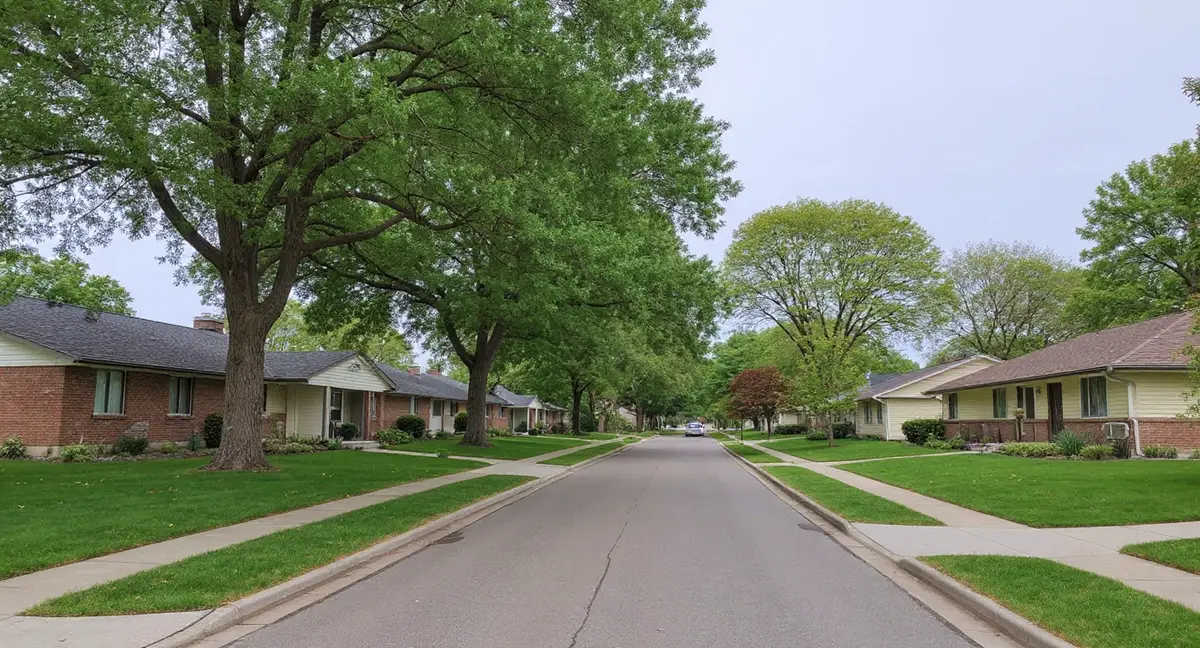
The old-town core — concentrated around Belton's downtown along Main Street, extending roughly from the railroad corridor east through the established residential grid — contains the city's highest-risk housing stock. These homes, predominantly built between 1945 and 1965, use concrete block basement walls set on shallow poured footings. Block construction distributes lateral soil pressure across mortar joints that are inherently weaker than the block units. After 60 to 70 years of prairie clay shrink-swell cycling, the mortar in these walls has undergone more stress cycles than any other residential construction type in the Kansas City metro. Stair-step cracks following the mortar joints are the signature distress pattern, and they are common throughout Belton's oldest neighborhoods.
Belton's newer peripheral development — along the Y Highway corridor, south of 163rd Street, and east toward the Route 58 interchange — mirrors Raymore's construction profile: post-1990 poured concrete basements and slab-on-grade homes on the same Cass County prairie clay. These homes are in the early exposure window, 15 to 35 years into their relationship with the clay, and are beginning to show first-generation symptoms. The difference from the old-town core is severity: newer construction is in the monitoring and prevention phase, while the old-town core is frequently in the active repair phase. The homeowner guide provides monitoring techniques appropriate for both stages.
The transition zone between old Belton and new Belton — where 1970s and 1980s homes bridge the gap — creates an intermediate risk band that is often overlooked. These mid-era homes, roughly 40 to 55 years old, combine the aging of their construction with the improved methods of the poured concrete era. They face the same 40-to-50-year cumulative exposure threshold that is currently driving visible symptoms across Blue Springs and the I-470 corridor in Lee's Summit. In Belton, this mid-era band is smaller than in those larger cities, but it represents the homes most likely to be crossing from symptom-free to first-observable-movement right now.
What Damage Patterns Distinguish Belton's Old-Town Core from Its Newer Neighborhoods?
In Belton's old-town block basements, the dominant failure pattern is horizontal cracking at the mid-height of the wall — the point of maximum inward deflection when the wall bows under sustained lateral pressure from expanding prairie clay. A horizontal crack at the midpoint of a block wall means the wall is actively displacing inward. The crack runs through the mortar bed joint at roughly the same height as the exterior soil level, because that is where the lateral pressure from saturated clay is greatest. Above and below that line, the wall is restrained — by the sill plate and floor structure above, and by the footing and floor slab below. The middle section has no lateral restraint, so it moves first.
Stair-step cracks in Belton's block walls are the second most common pattern, appearing at corners and near window openings where the wall geometry creates stress concentrations. These cracks follow the alternating bed-and-head joint pattern at approximately 45 degrees, tracing the weakest path through the masonry assembly. In a poured concrete wall, the same stress would produce a single diagonal crack through continuous material. In block construction, the crack finds every mortar joint along its path, creating the distinctive stepped pattern that gives the symptom its name. The stair-step crack page provides visual references for distinguishing between settlement-driven and pressure-driven stair-step patterns.
In Belton's newer subdivisions, the symptom profile shifts from block wall distress to slab-related indicators: cracked tile, uneven flooring, and seasonal door misalignment on exterior frames. Slab-on-grade construction responds to prairie clay movement from below rather than from the side. When the clay heaves beneath one section of slab and settles beneath another, the slab develops a differential elevation profile that makes hard flooring crack and causes doors to bind at their upper corners. These symptoms in Belton's post-2000 homes are typically seasonal — worst in May and June when the clay is at maximum expansion, improving somewhat by September when the clay has partially contracted.
Chimney separation is a specific risk in Belton's old-town homes that is less common in newer construction. Older homes with masonry chimneys built on independent footings are vulnerable to differential settlement between the chimney footing and the house foundation. The chimney, heavier per square foot than the adjacent wall, settles at a different rate on the same prairie clay — particularly when the chimney footing is shallower than the house footing or sits on fill soil from the original backfill. A gap opening between the chimney and the house wall, visible from outside, indicates the two structures are separating. The chimney separation page explains the mechanics and the structural significance of this pattern.
A 1955 Belton old-town home shows both horizontal cracking at mid-wall height and chimney separation from the house wall. What does the combination of these two symptoms reveal about the soil forces at work?
How Does Belton's Seasonal Weather Cycle Drive Foundation Damage?
Belton's annual 42 inches of rainfall — peaking at 5.7 inches in May — follows the same Kansas City metro pattern that drives foundation risk across the region, but Cass County's prairie clay responds to that rainfall with slightly different timing than Jackson County's Wymore-Ladoga. The organic content in prairie-derived clay slows both the wetting and drying phases: the clay absorbs spring rainfall gradually and releases summer moisture reluctantly. The practical effect is that peak expansion pressure against Belton foundations may lag the rainfall peak by two to three weeks — the clay is still expanding in early June even as rainfall volume begins to decrease. This delayed response means the symptom window extends later into early summer than in Jackson County suburbs.
For Belton's old-town block basements, the spring expansion period is the highest-risk window because lateral pressure against the already-compromised block walls is at its annual maximum. A block wall that has been cycling for 60 or 70 years has mortar joints that are progressively weaker than their original state. Each spring's peak pressure pushes the wall slightly further inward than it was before the previous dry season allowed it to partially recover. The wall does not fully return to its pre-spring position because the mortar joint damage from each peak is permanent. This ratcheting effect — each spring slightly worse than the last — is why old-town block walls tend to fail gradually over years rather than catastrophically in a single event.
Winter freeze-thaw within Missouri's 36-inch frost zone acts more aggressively on Belton's older shallow-footing homes than on newer construction built to code depth. A footing at 28 inches — plausible for a 1950s Belton home — sits within the frost zone where ice lens formation generates upward heave forces every winter. A footing at 36 inches or deeper is below the frost line and protected from direct heave. The difference is measurable: a shallow footing can be lifted 1/4 to 1/2 inch by a single severe freeze event, and it may not fully return to its original elevation when the soil thaws. Over 70 winters, this frost-related cumulative displacement compounds the clay shrink-swell damage to produce the multi-mechanism distress patterns visible in Belton's oldest homes.
What Should Belton Homeowners Prioritize Based on Their Home's Era?
Old-town Belton homeowners — those with 1940s through 1960s block basements — should prioritize professional evaluation of any visible foundation cracks, because block walls on 60-plus years of prairie clay cycling are in the late stage of their service life and cosmetic-looking cracks may indicate structural displacement that is not obvious from the interior. A horizontal crack at mid-wall height, a stair-step pattern wider than 1/4 inch, or visible inward bow are indicators that the wall has moved beyond normal cycling and is actively displacing. Wall anchors or carbon fiber straps can arrest that movement, but they are more effective and less expensive when installed before the wall has displaced significantly. Waiting until displacement reaches an inch or more changes the repair scope from stabilization to active straightening — a substantially more complex and costly procedure.
Newer-era Belton homeowners — those in post-1990 construction along the Y Highway corridor and southern development areas — should focus on drainage maintenance and baseline documentation. Gutters, downspout extensions, positive yard grading, and clear window well drainage are the primary tools for controlling how much moisture reaches the prairie clay adjacent to the foundation. These are not one-time installations. Grading settles over time, gutters clog seasonally, and downspout extensions get repositioned during yard work. An annual drainage audit each spring — checking grade, clearing gutters, verifying downspout discharge distance — is the lowest-cost intervention available. The repair cost page provides data on how drainage-related prevention compares to the cost of structural repair after damage has progressed.
For all eras of Belton construction, documenting crack width and location twice per year — once in September at minimum clay expansion and once in May at maximum — creates the monitoring record needed to distinguish seasonal cycling from progressive structural change. A crack that opens to 3/16 inch every May and returns to 1/8 inch every September is cycling with the clay. A crack that was 1/8 inch in September two years ago and is now 1/4 inch in September is progressing independently of the seasonal cycle — and that progression indicates active settlement or wall displacement that warrants evaluation. Monitoring is not a substitute for professional assessment when symptoms are already advanced, but it provides the data that distinguishes routine clay behavior from genuine structural movement.
- Belton's dual-era housing stock requires different evaluation approaches: old-town block basements from the 1940s-1960s face active repair-stage risk, while post-1990 peripheral homes face early monitoring-stage risk.
- Cass County prairie clay's organic content slows both wetting and drying phases — peak expansion pressure may lag the May rainfall peak by two to three weeks, extending the symptom window into early June.
- Old-town homes on shallow 1950s-era footings face both frost heave within Missouri's 36-inch frost zone and cumulative clay shrink-swell — a dual mechanical cycle that compounds damage over 70-plus winters.
- Crack monitoring twice per year — September at minimum expansion, May at maximum — distinguishes seasonal cycling from progressive displacement and determines whether repair is urgent or can be planned.
Belton Foundation Questions
Are Belton's 1950s block basements more vulnerable than newer poured concrete foundations?
Yes, significantly. Concrete block basements — the standard construction method in Belton's old-town core during the 1940s through 1960s — distribute lateral soil pressure across mortar joints that are weaker than the block units themselves. When Cass County prairie clay expands against a block wall, the mortar joints yield first, producing the characteristic stair-step crack pattern that follows the bed and head joints at 45-degree angles. Poured concrete walls, used in Belton's newer peripheral development, resist lateral pressure as a continuous structural element rather than relying on joint integrity. A 70-year-old block wall on prairie clay has undergone more than 70 full shrink-swell cycles, each one incrementally weakening the mortar joints — cumulative damage that poured concrete of the same age would resist more effectively.
Does Belton's old-town drainage infrastructure affect foundation risk?
Belton's downtown core was developed before modern stormwater management standards existed. Homes from the 1940s and 1950s often rely on aging clay tile drainage systems, shallow lot grading that may have flattened or reversed over decades, and gutter systems that discharge too close to the foundation. These drainage limitations mean that even moderate rainfall events can concentrate water at or near foundation walls in the old-town area. When combined with 60 to 70 years of accumulated soil settlement around the foundation, the drainage conditions in Belton's oldest neighborhoods create moisture loading patterns that amplify the prairie clay's natural shrink-swell cycle well beyond what the same clay produces under well-drained newer construction.
How does Belton's dual-era housing stock change the foundation risk picture compared to Raymore?
Raymore is almost entirely post-1990 construction on Cass County prairie clay — a single-era risk profile. Belton spans from the 1940s through the 2010s, which means it carries two distinct risk populations simultaneously. The old-town core faces cumulative damage on block basements with aging drainage — high-severity, repair-stage risk. The newer peripheral development faces early-exposure-window risk on slab-on-grade and poured concrete construction — lower severity, monitoring-stage risk. The two populations require different evaluation approaches, different repair methods, and different financial planning. Belton homeowners should identify which era their home belongs to before drawing conclusions from generalized foundation risk information.
What repair methods are most commonly needed for Belton's older downtown homes?
Belton's 1940s-1960s block basement homes most frequently require wall stabilization through carbon fiber straps or wall anchors — methods designed to arrest inward wall movement driven by decades of lateral clay pressure. Stair-step cracks in block walls that have progressed beyond cosmetic width indicate that the mortar joints have failed structurally, and the wall is actively displacing inward. Carbon fiber straps bond to the wall surface and resist further inward movement. Wall anchors extend through the wall into stable soil beyond the active clay zone to provide external resistance. The choice between these methods depends on the degree of displacement that has already occurred and whether the wall needs to be returned to its original position or simply stabilized in its current state.
Is foundation repair more or less expensive in Belton compared to other Kansas City suburbs?
Foundation repair costs in Belton fall within the same general range as the broader Kansas City metro — the methods, materials, and labor rates are regional, not city-specific. However, Belton's older downtown homes can involve higher repair complexity because of the block construction type, limited access in older neighborhoods with narrow lot lines, and the potential need for drainage system replacement as part of a comprehensive repair scope. A wall anchor installation on a block basement in old-town Belton may cost more than the same method on a poured concrete wall in a newer subdivision, because the block wall may require additional preparation, and the older lot layout may complicate equipment access.